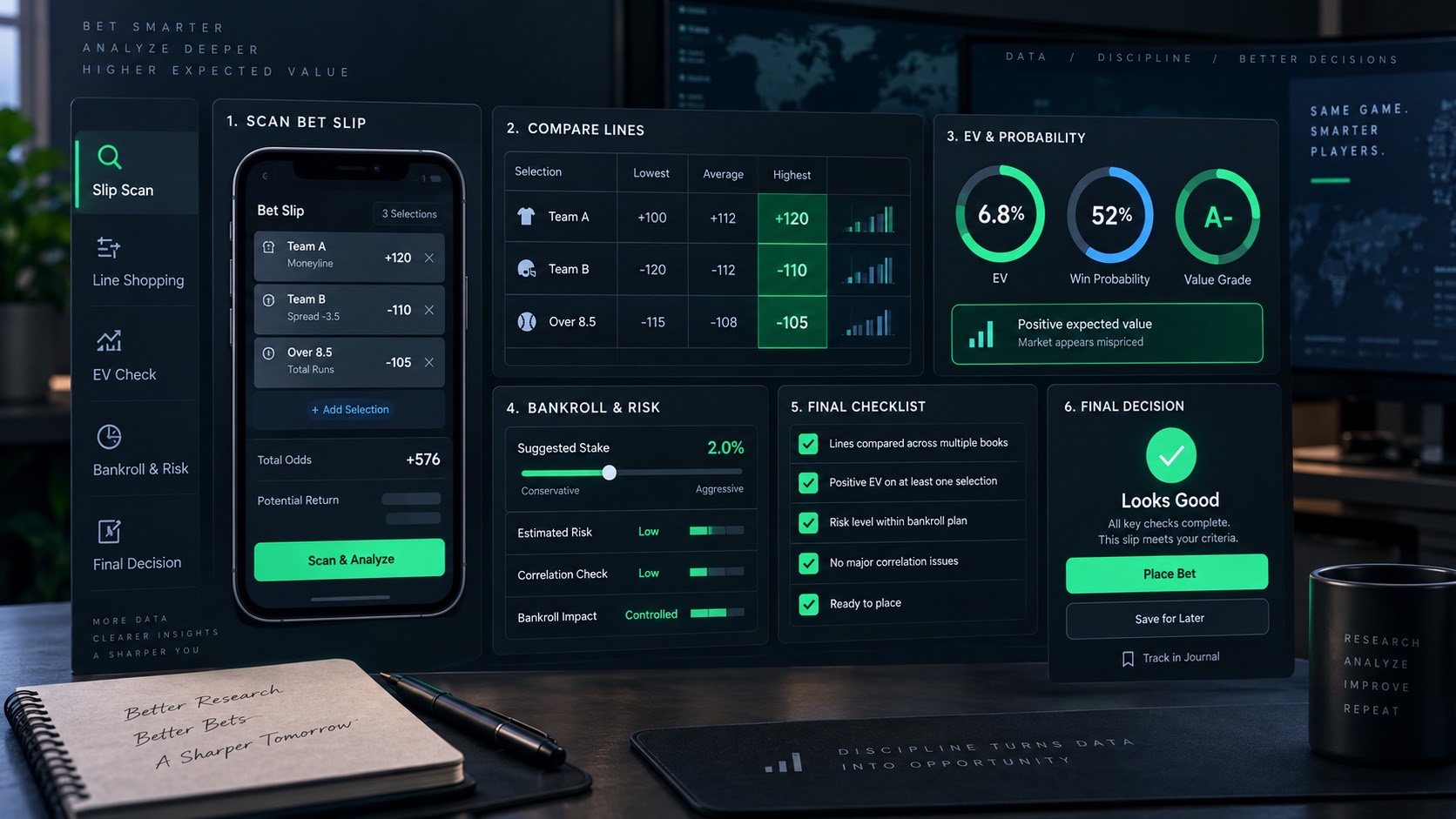
What a bet slip review should answer
A good bet slip review does not ask whether the pick feels right. It asks whether the exact price on the exact market is worth risking money at the exact stake on the screen. That distinction matters because a smart handicap can become a bad bet after the market moves, the book posts a worse number, a parlay leg duplicates exposure, or the stake breaks your bankroll rules.
The workflow below is built for real slips: straight bets, player props, parlays, same-game parlays, futures, and live bets. It pairs well with a bet slip scanner app, but it also works manually with an odds screen, odds converter, EV calculator, and bet tracker spreadsheet.
Key takeaways
- Review the slip, not just the pick. Market, line, odds, stake, sportsbook rules, and timing all affect the final decision.
- Price comes before prediction. A bet with a reasonable opinion can still be negative EV if the book price is too expensive.
- Parlays need leg-level review. If one leg would fail as a straight bet, combining it with other legs usually makes the problem harder to see.
- Context checks should be specific. Injuries, weather, lineup news, role changes, and market movement matter when they change the probability behind the price.
- The review is incomplete until the bet is logged. Stake, odds, closing line, reason, and result create the feedback loop.
The 7-step bet slip review workflow
Confirm sport, market, side, line, odds, stake, event time, and whether the slip is straight, parlay, SGP, teaser, or futures.
Compare the exact market across books. A better price can move the break-even rate enough to change the bet.
Use implied probability so the decision is stated in percentages instead of vibes.
Use your model, projection, prop research, injury context, or market reference to set a fair number.
Run expected value, then check whether parlay or SGP legs support, fight, or duplicate the same game script.
Cap risk with unit size, flat betting, or fractional Kelly. No slip deserves a stake that can wreck the bankroll.
Record odds, stake, book, fair probability, closing line, result, and review notes before the lesson disappears.
Slip review table
| Review layer | Question to answer | Tool or internal link |
|---|---|---|
| Market identity | Is the slip showing the exact side, total, prop, line, period, and rules you meant to bet? | AI bet slip analyzer |
| Price quality | Can another sportsbook beat this number, or has the market already moved away? | odds scanner app and line shopping guide |
| Probability | What win rate does this price require after converting the odds? | odds converter |
| Expected value | Does your fair probability beat the break-even probability by enough to justify the risk? | EV calculator and positive EV betting app |
| Parlay risk | Would each leg still make sense alone, and are same-game legs correlated in a way the price does not reflect? | parlay analyzer app and SGP correlation guide |
| Stake risk | Does the stake fit your bankroll plan, daily cap, and unit-size rules? | unit size calculator and Kelly calculator |
| Review loop | Will you be able to evaluate the decision later using CLV, ROI, and notes? | CLV tracker and bet tracker spreadsheet |
When the workflow should reject a slip
The easiest way to improve a betting process is to skip more bad submissions. Reject the slip when the best available price is worse than your fair line, when the model edge depends on stale news, when one parlay leg is only included to boost payout, or when the stake was chosen because the bet feels urgent. A no-bet is a decision, not a failure.
- Bad price: another book has a meaningfully better number, or the line has moved past your target.
- Thin edge: the EV depends on an overconfident probability estimate with no margin for model error.
- Hidden duplicate risk: multiple legs need the same fragile game script to hit.
- Weak context: injury, lineup, weather, or role information is missing when it directly affects the market.
- Stake creep: the bet is larger than your normal unit because of confidence, tilt, or chasing.
- No tracking: you would not be able to explain the bet later from the logged data.
How apps fit into the review
Automation is strongest at the boring parts: reading the slip, identifying legs, comparing prices, converting odds, flagging parlay structure, and drafting a plain-language review. The best sports betting research apps still need human supervision, because a tool can misread a market, miss a book-specific rule, or make a probability estimate sound cleaner than it is.
Useful when the workflow starts from a screenshot. They should parse legs and push the bettor into price and EV checks.
Useful when the primary question is whether the current book is offering a beatable price.
Useful after placement, when CLV and review notes are more informative than one result.
Context checks that actually change the bet
Context belongs in the workflow only when it changes probability. For NFL bets, official injury designations separate practice participation from game status, and current player status can change the meaning of a side, total, or prop. For outdoor sports, weather belongs in the slip review when wind, precipitation, temperature, or field conditions change the assumptions behind the market. For bankroll discipline, responsible-betting guidance consistently points bettors back to budget limits and informed play.
That does not mean every slip needs a full scouting report. It means the final bet should survive the few checks that matter most for that market: injuries and usage for props, weather for outdoor totals and kicking markets, lineup news for baseball and basketball, and sportsbook hold or no-vig price for markets where the tax is unusually high.
Example: reviewing a three-leg slip
Suppose a bettor builds a three-leg slip: Team A moneyline at +120, Team B spread -3.5 at -110, and Over 8.5 at -105. The workflow starts by confirming each market and price. Then it compares the numbers across books. If Team A is available at +128 elsewhere, the original slip is already inferior. If the Over price is tied to a weather-sensitive game and the forecast changed, the probability estimate needs to be updated before EV is calculated.
Next, each leg should pass as a standalone decision. A parlay payout can make weak legs look useful because the combined number is larger, but the bet still inherits every leg-level mistake. If all three legs pass, the bettor can size the position more conservatively than a straight bet, log the fair probability assumptions, and review the closing line later.
FAQ
What is the fastest way to review a bet slip?
The fastest reliable flow is: scan the slip, confirm each leg, shop the price, convert odds, run EV, check correlation, cap stake size, and log the bet. Skipping line shopping or stake review usually saves seconds while risking the entire edge.
Can a bet slip review workflow be used for live betting?
Yes, but it needs tighter rules. Live markets move quickly, so the workflow should use pre-set price targets, small stake caps, and a hard pass when the line changes before the calculation is complete.
Is this different from handicapping?
Yes. Handicapping estimates the matchup or player outcome. Bet slip review checks whether the offered price, stake, correlation, rules, and timing make that opinion worth betting.
Sources
- NFL.com injury report for official player practice and game-status context.
- National Weather Service for official U.S. weather forecasts and warnings.
- American Gaming Association responsible play guidance for budget and informed-play principles.
- National Council on Problem Gambling safer sports betting resources for help and responsible-gambling context.