Sports Betting Hedge Calculator: Formula and Examples
A hedge calculator does one useful thing: it translates an existing ticket and an opposite price into the stake needed to lock profit, limit loss, or smooth a scary payout swing.
Last updated: August 18, 2026
Key Takeaways
- A sports betting hedge calculator starts with your current payout. The original ticket's possible return determines how much opposite-side stake is needed.
- The equal-profit formula is simple. Original stake x original decimal odds / hedge decimal odds = hedge stake.
- A break-even hedge is smaller. It only protects the original stake if the first ticket loses, so it preserves more upside if the first ticket wins.
- Hedging can be rational or expensive. The key question is whether the risk reduction is worth the expected value you give up.
- Best use cases are futures, parlays, live bets, and emotional-risk tickets. The math belongs beside arbitrage, line shopping, and bet tracking.
What Is a Sports Betting Hedge Calculator?
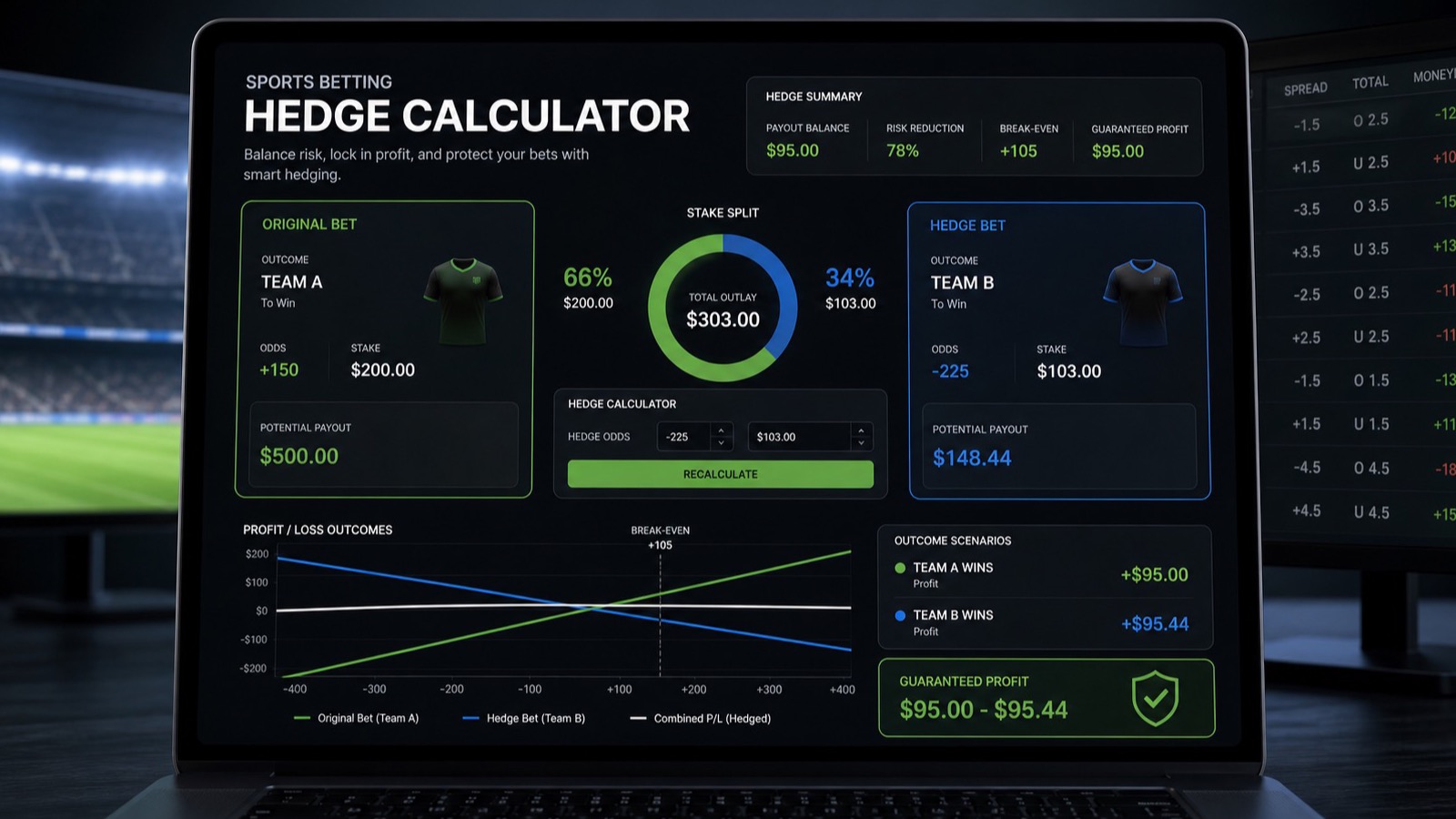
A sports betting hedge calculator sizes a second bet against an existing position. You already have one ticket. The calculator asks: if you bet the other side at the current price, what stake creates the payout shape you want?
The goal might be equal profit, reduced downside, a break-even floor, or a custom split where you keep most of the upside but stop the original ticket from becoming all-or-nothing. That makes hedging different from blindly "locking something in." The calculator gives the numbers; the bettor still has to decide whether those numbers are worth accepting.
Hedging is most common when the original bet has changed in value. A futures ticket reaches the final, the last leg of a parlay is pending, or a live market moves enough that the opposite side becomes a tool for risk control.
The Equal-Profit Hedge Formula
First convert both prices to decimal odds. If you only have American odds, run them through the odds converter.
Original return: original stake x original decimal odds
Equal-profit hedge stake: original return / hedge decimal odds
Profit if original wins: original return - original stake - hedge stake
Profit if hedge wins: hedge stake x hedge decimal odds - original stake - hedge stake
This is the same core logic used by hedge calculators from betting tools such as Smarkets and OddsJam: size the opposite bet from the potential return of the first position, then compare the payout under both outcomes.
Example: Hedge a Futures Ticket
Suppose you have a $100 futures ticket at +450. Your team reaches the final, and the opponent is now available at +130.
| Input | Value | Decimal odds |
|---|---|---|
| Original futures stake | $100 at +450 | 5.50 |
| Original total return | $550 | $100 x 5.50 |
| Available hedge price | Opponent +130 | 2.30 |
| Equal-profit hedge stake | $239.13 | $550 / 2.30 |
Now compare the outcomes:
| Outcome | What wins | Net result |
|---|---|---|
| Your futures team wins | Original +450 ticket | $550 return - $100 stake - $239.13 hedge = $210.87 profit |
| Opponent wins | +130 hedge bet | $239.13 x 2.30 - $100 original stake - $239.13 hedge = $210.87 profit |
The hedge turns a possible $450 profit or $100 loss into about $211 profit either way. That is a real reduction in variance, but it also gives up $239 of upside if your original ticket wins.
Break-Even Hedge Formula
Sometimes equal profit is not the goal. You may only want to avoid losing the original stake while preserving as much upside as possible.
Break-even hedge stake: original stake / (hedge decimal odds - 1)
Break-even result if hedge wins: hedge profit - original stake = about $0
Using the same example, the break-even hedge at +130 is $100 / (2.30 - 1), or $76.92. If the opponent wins, the hedge earns about $100 profit and offsets the original loss. If your futures ticket wins, your net profit is $550 - $100 - $76.92 = $373.08.
Custom Hedge: The Better Real-World Option
Most serious hedge decisions are not pure equal-profit or pure break-even. They are custom risk decisions. You might want to guarantee $100 but leave $300 of upside. Or you might hedge only enough to lower one ugly loss scenario, then keep the rest of the ticket live.
- Calculate the no-hedge outcome. Know the full upside and full downside before touching anything.
- Calculate the equal-profit hedge. This gives the maximum smoothing reference point.
- Calculate the break-even hedge. This gives the minimum protection reference point.
- Choose a stake between them. That lets you balance guaranteed floor against upside.
- Log the decision. Record why you hedged in your CLV tracker or betting log so you can review the process later.
Hedge Calculator for Parlays
Parlay hedging is usually a last-leg problem. You hit the early legs, one event remains, and the sportsbook is showing a cash-out offer or the market offers an opposing bet.
Use the same formula, but treat the parlay's possible payout as the original return. If a $25 parlay can return $600 and the opposite side of the final leg is available at -150, the hedge decimal odds are 1.67. An equal-profit hedge would be about $359.28 because $600 / 1.67 = $359.28.
That looks clean, but it may be too expensive for a small parlay. A break-even hedge would be $25 / (1.67 - 1), or about $37.31. That smaller hedge protects the original parlay stake while keeping far more upside alive.
Hedge vs Cash Out
A sportsbook cash-out offer is a built-in hedge with a price chosen by the book. Sometimes it is convenient. Sometimes it is a worse price than creating your own hedge in the open market.
- Cash-out offer: the guaranteed amount the book is offering now.
- DIY hedge floor: what you can guarantee by betting the opposite side yourself.
- Unhedged EV: the ticket's value if your fair probability estimate is better than the market's.
- Liquidity and limits: whether the opposite bet is actually available at the size your calculator requires.
If the cash-out offer is lower than a simple market hedge, the convenience has a cost. If the market hedge requires moving money to another sportsbook, accepting a slightly worse cash-out may still be rational for a small recreational ticket.
Hedge vs Arbitrage vs Positive EV
These terms overlap, but they answer different questions:
| Workflow | Main question | Typical tool |
|---|---|---|
| Hedging | How do I reshape the payout of a bet I already have? | Hedge calculator |
| Arbitrage | Do prices across every side add to less than 100%? | Arbitrage calculator |
| Positive EV | Is this one price better than my fair probability? | EV calculator |
The biggest mistake is hedging a clearly +EV position only because the payout feels large. If your original ticket is still priced better than the market, a hedge may reduce the emotional swing while lowering the mathematical value. That can be fine, but name the trade honestly.
When Hedging Makes Sense
- The ticket is oversized for your bankroll. If one outcome would create an uncomfortable drawdown, hedge math can restore sane exposure.
- The price moved strongly in your favor. A futures or live bet may now be valuable enough to convert some paper edge into a real floor.
- You need liquidity, not max EV. Recreational bankrolls sometimes benefit from reducing a single large binary outcome.
- The hedge price is fair or better. If the opposite side is also a good number, the hedge can be more than emotional insurance.
- The ticket is hard to replace. Futures, promos, and long parlays can justify partial hedges because the original position is unusual.
When Hedging Is Usually a Leak
- The hedge price is bad. Paying heavy vig to reduce nerves is expensive over time.
- The original stake is tiny. Hedging a small fun ticket can create complexity without meaningful bankroll benefit.
- You are hedging every winner. If every longshot gets flattened, your upside disappears while your losing tickets remain full-sized.
- You did not compare cash-out and market prices. Convenience should be priced, not assumed free.
- You are avoiding a staking mistake after the fact. Fix future exposure with a unit-size calculator, not with repeated emergency hedges.
Hedge Calculator Checklist
- Confirm the same market. Full game vs regulation time, listed-pitcher rules, overtime rules, dead-heat rules, and bet-settlement terms can change the outcome.
- Refresh the hedge price. Live odds move quickly, especially around injury news, game state, and final parlay legs.
- Check bet limits first. The calculator might call for $239.13, but the book may limit you to less.
- Compare at least two books. A slightly better hedge price can materially improve the guaranteed floor.
- Record the final payout map. Log original stake, original odds, hedge odds, hedge stake, cash-out offer, guaranteed floor, and unhedged upside.
Audit the Hedge Before You Flatten the Ticket
Use Juice to analyze a bet slip screenshot, compare price quality, and sanity-check whether the hedge gives up too much upside for the risk it removes.
Download Juice on iOSFAQ
What is a sports betting hedge calculator?
A sports betting hedge calculator tells you how much to bet on the opposite side of an existing wager so the final payout is smoother. It can target equal profit, break-even protection, or a custom guaranteed floor.
How do you calculate a hedge bet?
For an equal-profit hedge, multiply your original stake by the original decimal odds, then divide by the hedge decimal odds. For a break-even hedge, divide your original stake by the hedge decimal odds minus 1.
Should I hedge a futures bet?
Hedge a futures bet only when the risk reduction is worth the upside you are giving away. Large tickets, favorable line movement, and bankroll pressure can justify a hedge; tiny fun tickets and bad opposite-side prices usually do not.
Should I hedge a parlay before the last leg?
Sometimes. Calculate the equal-profit hedge, the break-even hedge, and the sportsbook cash-out offer before deciding. A partial hedge often makes more sense than flattening the whole parlay.
Is hedging profitable long term?
Hedging is a risk-management decision, not a profit system by itself. It can protect bankroll and lock gains, but repeated hedging at poor prices can reduce long-term expected value.
Sources and References
- Smarkets: hedge bet calculation formula
- OddsJam: arbitrage and hedge bet calculator workflow
- Action Network: sports betting hedging calculator
- Pinnacle: arbitrage calculator and implied probability reference
- National Council on Problem Gambling: responsible sports gambling principles
BetResearcher is an independent research site. This guide is educational, not financial advice or a guarantee of profit. Sports betting involves risk, and you should only bet where legal and with money you can afford to lose.