Flat Betting Strategy for Sports Betting Unit Size
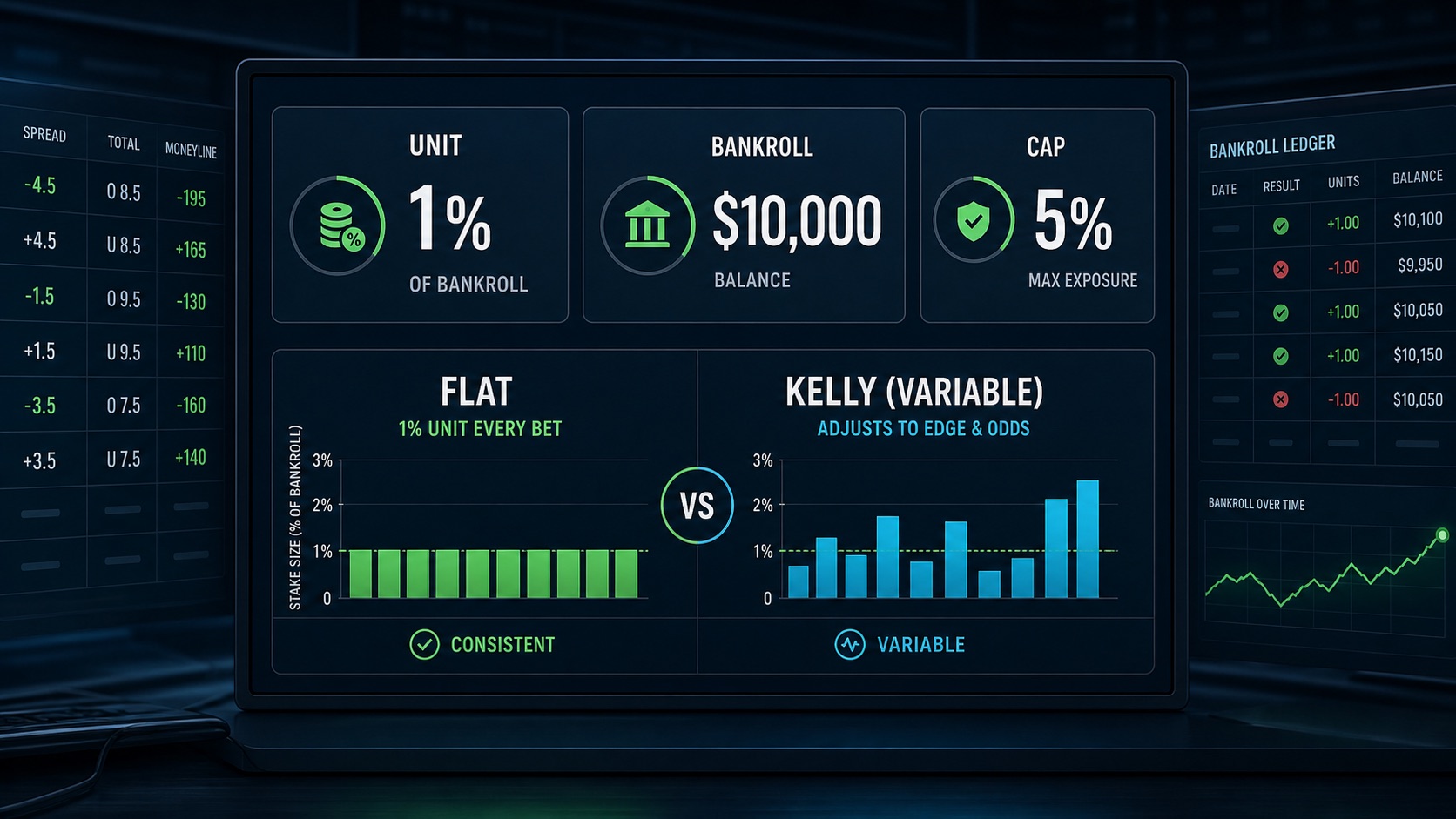
Flat betting turns stake sizing into a repeatable bankroll rule: one defined unit, one risk cap, and no emotional resizing after wins or losses.
Key takeaways
- Flat betting is a risk rule, not a prediction system. It controls how much you risk after a bet qualifies.
- One unit should be defined before the slate starts. Many conservative bettors use 0.5% to 1% of bankroll as a normal unit.
- Flat staking is useful when edge estimates are noisy. If you cannot defend the exact probability input, fixed sizing is often cleaner than aggressive variable sizing.
- Expected value still comes first. A flat bet at a bad price is still a bad bet.
- Recalculation should be scheduled. Change unit size after a bankroll review, not after a hot streak or a tilt loss.
What is flat betting?
Flat betting is a sports betting staking strategy where each approved wager gets the same stake size. Instead of betting more because a pick feels strong or less because the last bet lost, you use a fixed unit.
The unit is usually a percentage of bankroll. If your bankroll is $2,000 and your flat unit is 1%, one unit is $20. A normal bet risks $20 whether the odds are -110, +125, or +200, unless your written rules say that market type gets a smaller unit.
That makes flat betting a good default for bettors who are still learning to estimate probability, compare sportsbook prices, and track results. It also creates a clean audit trail: when every normal bet is one unit, your record is less distorted by oversized outliers.
Flat betting formula
The basic formula is simple:
Flat bet stake = Bankroll x Unit percentage
For example, a $2,000 bankroll with a 1% unit creates a $20 stake. A $5,000 bankroll with a 0.5% unit creates a $25 stake. Use the bankroll management calculator to set the number before you start betting.
Flat betting unit size examples
The right unit depends on bankroll size, bet frequency, market volatility, and your confidence in the edge estimate. For most bettors, the mistake is not choosing 0.8% instead of 1%. The mistake is letting the number drift every time emotions change.
| Bankroll | 0.5% unit | 1% unit | 2% unit |
|---|---|---|---|
| $500 | $2.50 | $5 | $10 |
| $1,000 | $5 | $10 | $20 |
| $2,500 | $12.50 | $25 | $50 |
| $10,000 | $50 | $100 | $200 |
A 2% unit is twice as volatile as a 1% unit. That sounds obvious, but it matters during drawdowns. A bettor placing 30 to 60 bets per month needs enough room for normal variance without feeling forced to abandon the process.
When flat betting works best
Early tracking
Use fixed stakes while you learn whether your process beats breakeven after vig.
Soft edges
Manual research, AI summaries, and analyst reads often produce directionally useful but imprecise probabilities.
High bet volume
A fixed unit keeps one aggressive opinion from dominating the whole month.
Emotional control
The rule removes the temptation to double after losses or chase a recent win streak.
Flat betting vs Kelly betting
Flat betting and Kelly Criterion betting answer the same question in different ways: how much should you risk after you find a possible edge?
Kelly sizing changes the stake based on your edge, odds, and bankroll. That can be powerful when the probability estimate is accurate. The original Kelly paper framed optimal growth as a long-run capital growth problem, and later gambling literature expanded the idea for favorable games. But the practical catch is brutal: bad inputs create bad stake sizes.
Flat betting is less theoretically efficient, but it is harder to abuse. If your edge estimate is "this looks good" rather than a tracked probability, flat staking usually beats pretending precision exists.
| Approach | Stake behavior | Best fit | Main risk |
|---|---|---|---|
| Flat betting | Same normal unit each bet | Noisy edges, early tracking, recreational discipline | Can underbet the strongest real edges |
| Quarter Kelly | 25% of full Kelly output | Measured edge with model-error protection | Still depends on probability accuracy |
| Full Kelly | Maximum growth fraction | Clean theoretical edge and high confidence | Too volatile for most sports betting workflows |
A clean middle ground is to start with flat betting, then use the quarter Kelly guide only for bets where you can defend a probability estimate and accept the variance.
Flat betting does not fix negative EV
Stake discipline cannot rescue bad pricing. If a sportsbook line implies a 52.4% breakeven rate and your fair probability is 49%, betting one unit is still a long-run leak.
The order should be:
- Convert the offered odds with the odds converter.
- Remove or estimate sportsbook margin with the no-vig odds guide when comparing both sides of a market.
- Check whether your fair probability clears the price with the EV calculator.
- Only then apply your flat unit size.
A practical flat betting workflow
- Define bankroll. Use money set aside for betting only, not rent, savings, or money you plan to replace later.
- Pick one normal unit. Start conservatively, often 0.5% to 1% of bankroll.
- Set a daily exposure cap. A flat bettor still needs a limit for total risk across correlated games and props.
- Qualify bets by price. Use implied probability, no-vig probability, and expected value before stake sizing.
- Record in units. Track +1.0, -1.0, +0.91, or +1.25 units instead of only dollars.
- Review on schedule. Recalculate unit size weekly, monthly, or after a predefined bankroll move.
Should you use a 1% betting unit?
A 1% unit is a sensible default for many disciplined bettors because it gives the bankroll room to survive losing streaks while still making results meaningful. It is not magic. It is just a simple guardrail.
Use less than 1% if you are testing a new model, betting volatile markets, playing many correlated props, or still learning to estimate probability. Consider more than 1% only when you have a real edge record, clear limits, and the discipline to reduce size when the bankroll falls.
The American Gaming Association's responsible play guidance emphasizes setting a budget, knowing the game, and taking breaks when needed. That aligns with flat betting: the unit should be part of a larger budget and limit system, not a loophole for more action.
Common flat betting mistakes
- Changing the unit after every result. Recalculate on a schedule, not after a single win or loss.
- Calling every bet one unit. Long shots, correlated parlays, and thin props may need smaller default risk.
- Ignoring price movement. If the market moved, rerun the EV check at the current line.
- Tracking only dollars. Units make performance comparable as bankroll size changes.
- Using flat betting to justify action. A small bad bet is still negative expected value.
FAQ
What is flat betting in sports betting?
Flat betting means risking the same unit size on each qualifying bet, usually a fixed percentage of bankroll such as 0.5%, 1%, or 2%.
What unit size should a flat bettor use?
A conservative flat bettor often starts around 1% of bankroll per bet, then adjusts only after a planned bankroll review rather than after a single win or loss.
Is flat betting better than Kelly?
Flat betting is often better when your probability estimates are uncertain or untracked. Kelly sizing can be more efficient when you have a well-calibrated edge estimate.
Can flat betting make negative-EV bets profitable?
No. Flat betting controls stake size, but it does not turn bad prices into good bets. You still need positive expected value.
Sources and references
- John L. Kelly Jr.: A New Interpretation of Information Rate
- Edward O. Thorp: Optimal Gambling Systems For Favorable Games
- American Gaming Association: Responsible Play
Next steps
Use flat betting as the staking layer after your price check. Then connect it to the full BetResearcher workflow: bankroll management, expected value, closing line value, and Kelly sizing when you have a measured edge.