Horse Racing Betting Research Workflow
A practical workflow for researching horse racing bets: track runners, jockeys, trainers, race conditions, odds formats, stake size, and review notes before the market turns a hunch into a wager.
Last updated: September 22, 2026
Why horse racing needs a different workflow
Horse racing betting is not just another moneyline market. The same horse can look very different by course, distance, going, race class, draw, pace shape, jockey booking, trainer intent, and recent schedule. A casual bettor sees a price. A disciplined bettor sees a chain of assumptions that needs to be checked before the stake is decided.
The goal is not to make racing predictable. It is to slow the decision down enough that you can separate a real note from a familiar name, a better price from a worse one, and a manageable stake from a chase bet.
The horse racing research stack
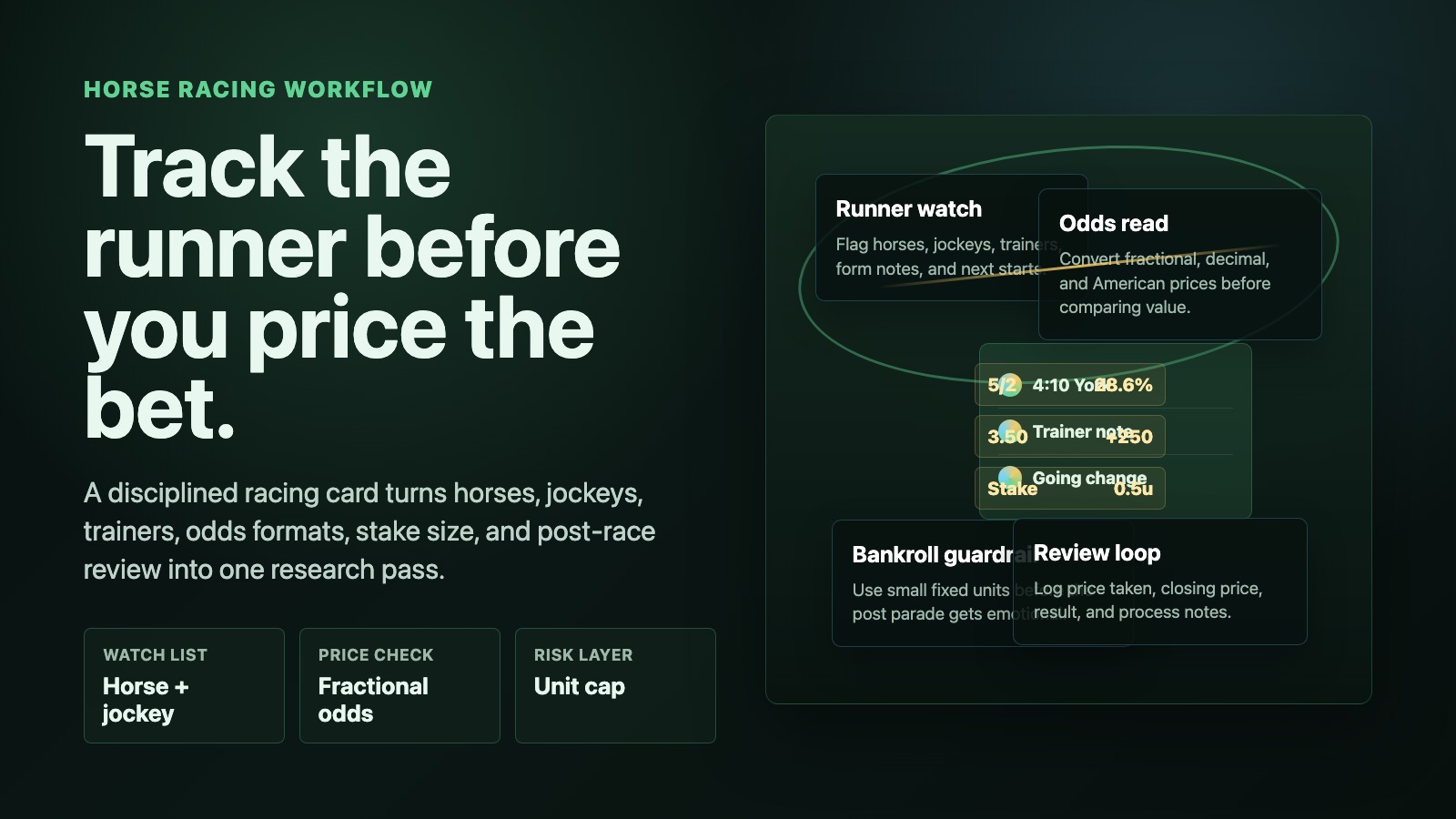
Track the runner before you price the bet
The cleanest racing workflow starts before the odds screen. If a horse, jockey, or trainer catches your attention, save the reason while it is fresh. Was the horse blocked in running? Was the jockey change meaningful? Did a trainer place the horse differently next time? Those notes are only useful if they are easy to find when the horse appears on a new card.
For UK and Irish racing, StableBet's Horse Tracker is a natural fit for this step. It lets bettors star horses, jockeys, and trainers, then see when they run again. That belongs at the top of the workflow: first identify what you are tracking, then decide whether the current price is worth betting.
Read the race before reading the odds
A racecard is not just a list of names. It is the context that decides whether a prior note still applies. Before betting, check the basics: course, distance, surface, going, race type, field size, draw, weight, equipment changes, layoff, and whether the horse is moving up or down in class.
For U.S. racing, entries pages such as Equibase show how structured racecards organize runners, trainers, jockeys, race conditions, and program information. The same principle applies anywhere: the price only means something after you understand the conditions the horse is actually facing today.
| Research item | Why it matters | BetResearcher tool |
|---|---|---|
| Horse, jockey, trainer note | Creates a reason to revisit a future race instead of betting from memory. | StableBet Horse Tracker |
| Fractional or decimal price | Needs a common probability base before you compare books or U.S. prices. | Odds converter |
| Fair probability estimate | The bet only has value if your estimate beats the market hurdle. | EV calculator |
| Stake size | Racing variance can be brutal, especially with longer prices and each-way exposure. | Unit size calculator |
| Result and closing price | A review log shows whether the process is improving, not just whether one horse won. | Bet tracker spreadsheet |
Convert racing odds into implied probability
Horse racing bettors often move between odds formats. UK and Irish racing commonly uses fractional odds. Many international markets use decimal odds. U.S. sportsbooks often use American odds. Those formats look different, but they all answer the same question: what win probability does this payout require?
Use the BetResearcher odds converter to translate prices into one common view. A 5/2 price, 3.50 decimal, and +250 American price all describe the same payout relationship before margin and market movement are considered. Once the price is converted, compare it with your fair estimate and avoid treating a familiar horse as a value bet just because the number looks large.
Run the EV check separately from the racing opinion
A racing opinion is not the same thing as a bet. You might like a horse's setup and still pass if the price is too short. You might dislike the favorite and still avoid betting against it if the alternatives are also underpriced. The EV calculator forces the opinion to clear a price hurdle.
For example, if your fair estimate says a horse wins 24% of the time, the rough fair decimal price is 4.17. If the market offers 3.50, the price is probably too short for that estimate. If the market offers 5.00, the bet may deserve a second look, but only after you inspect limits, rules, each-way terms, and whether your probability estimate is defensible.
Keep stake size boring
Horse racing can tempt bettors into oversized stakes because the prices are larger and the stories are vivid. That is exactly why the staking rule should be decided before the race. Use a fixed unit, a conservative percentage of bankroll, or a hard max stake. Do not let a strong note become a bankroll-level bet.
The bankroll calculator examples, unit size calculator, and flat betting strategy guides are the right companions here. Kelly-style staking can be dangerous when your true probability estimate is fragile, so most racing bettors should start smaller and review a long sample before scaling up.
Log the bet and review the process
The review loop is where racing notes become useful. Log the horse, race, course, going, price taken, closing price, stake, result, and the reason for the bet. The result matters, but the process note matters more. Did the horse shorten because your read was early? Did the price drift because the market disagreed? Did the bet lose for a reason you should have seen?
A simple bet tracker spreadsheet is enough. The key is consistency. If you only track winners, you are collecting trophies. If you track every researched bet, you are building feedback.
Example workflow
Say you follow a horse after a troubled run. You star the horse in a tracker and add a note: blocked late, finished with room, worth checking next time at a similar trip. A week later, the tracker shows that the horse is declared again. Now the workflow starts.
First, check the racecard. Is the distance similar? Is the going comparable? Has the jockey changed? Is the field shape likely to create the same traffic problem? Next, convert the available odds and compare books. If your fair estimate is 22% and the best available price implies 18%, the bet may have room. If the best available price implies 27%, the story is not enough. Finally, stake small, log the bet, and review the closing price and result after the race.
FAQ
What is the best first tool for horse racing betting research?
The best first tool is a tracker or note system for horses, jockeys, and trainers. Racing markets move quickly, and memory is unreliable. Track the reason a runner matters, then use odds conversion and EV checks before staking.
Should I bet every horse I track?
No. A tracker creates a research queue, not a bet list. Many tracked horses will be the wrong price, in the wrong race, or too risky for the bankroll. The point is to know what to inspect, not to force action.
How do I compare fractional odds with American odds?
Convert both prices into implied probability. Fractional odds such as 5/2 can be converted into decimal odds of 3.50, which is equivalent to +250 American odds. The odds converter handles that translation instantly.
Sources
- StableBet Horse Tracker for horse, jockey, and trainer watch-list workflow.
- Equibase entries for structured race entry and racecard context.
- NYRA entries for racecard and runner information examples.
- GambleAware for safer gambling support and responsible-play context.