Quick answer
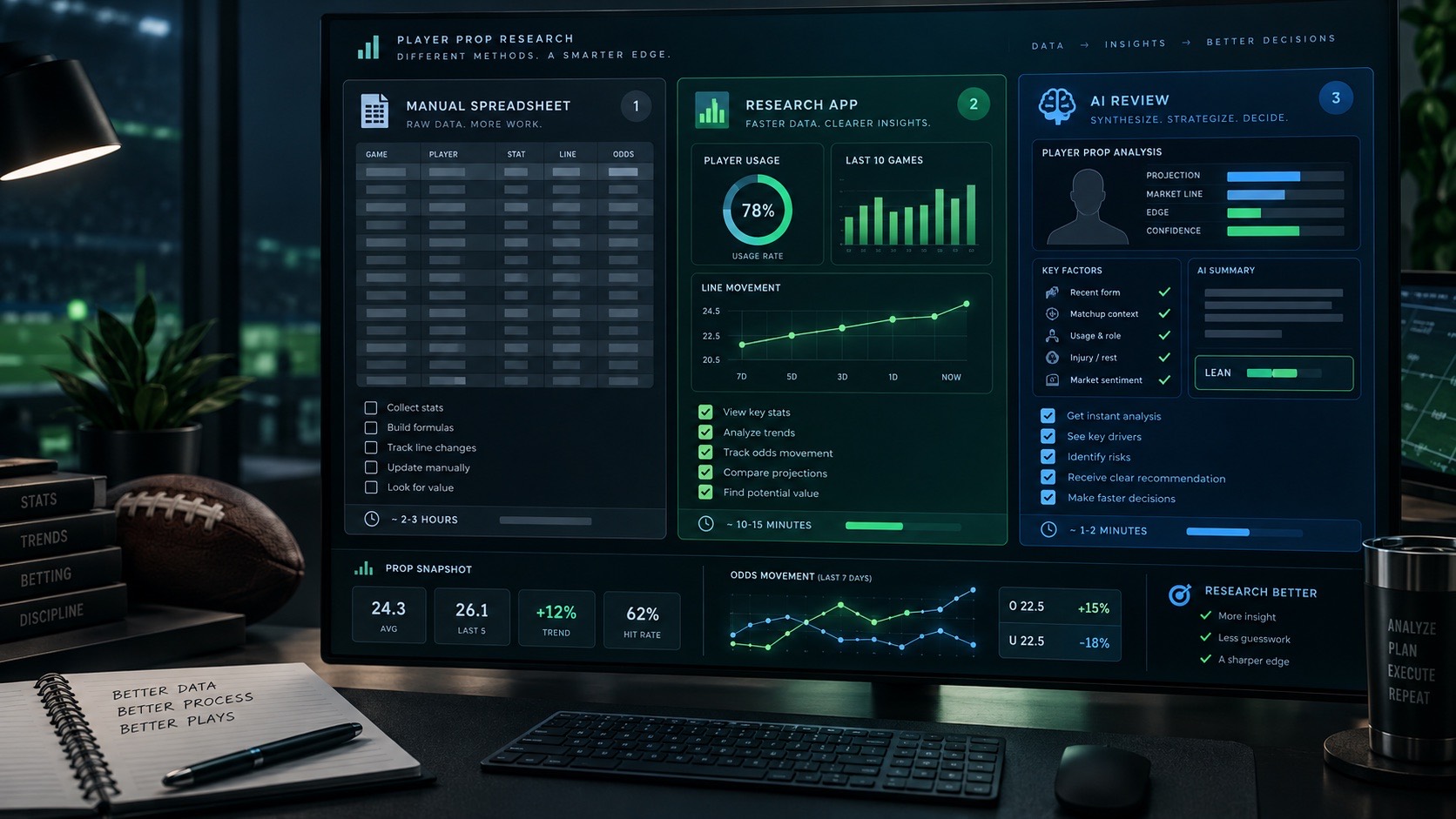
The best player prop research workflow uses three layers: a data layer for role, usage, matchup, and injury context; a market layer for line shopping, implied probability, line movement, and expected value; and a review layer for stake size, bet tracking, and closing-line feedback. A spreadsheet gives control, a player prop research app gives speed, and AI is useful as an audit assistant rather than the final decision maker.
This comparison is built for bettors deciding whether to research props manually, use a dedicated player props research process, add an AI player prop research tool, or assemble a broader sports betting software stack.
Key takeaways
- Manual spreadsheets are best when your projection logic is proprietary and you want full control over assumptions.
- Prop research apps are best when speed matters: filtering markets, comparing hit rates, checking trends, and monitoring odds movement.
- AI review is strongest as a second reader that summarizes news, flags weak assumptions, and translates the bet case into plain language.
- The workflow is incomplete without line shopping. A good projection can become a bad bet if the available price is stale or expensive.
- Track the result and closing line. Without a feedback loop, the workflow becomes content consumption instead of process improvement.
Player prop workflow comparison
| Workflow | Best use case | Weak spot | Internal support |
|---|---|---|---|
| Manual spreadsheet | Custom projections, repeatable formulas, niche sports, and transparent assumptions. | Slow data entry, missed news, harder odds comparison, and more stale inputs. | bet tracker spreadsheet |
| Prop research app | Usage filters, trend screens, matchup views, injury context, line movement, and fast shortlist building. | Can hide methodology, overemphasize historical hit rate, or make screenshots feel more certain than they are. | best sports betting software |
| AI review | Summarizing player context, checking the logic of an over or under, and spotting missing research questions. | Can hallucinate sources, miss sportsbook rules, or sound confident without verifying price and timing. | AI sports betting research |
| Odds screen | Finding the best available number, watching market movement, and avoiding a worse break-even rate. | Shows price better than probability. You still need a fair estimate. | odds scanner app |
| Hybrid stack | Bettors who want app speed, spreadsheet accountability, AI critique, and CLV review in one process. | Tool sprawl. Too many dashboards can delay the actual decision. | sports betting research app reviews |
The 8-step player prop research workflow
Write down the player, stat, over or under, line, odds, sportsbook, game time, and whether alternates are available.
Start with minutes, snaps, routes, touches, targets, shots, plate appearances, or another sport-specific opportunity metric.
Review injuries, lineup changes, rest, matchup, game script, and weather when the prop depends on outdoor conditions.
Use line shopping to find whether the current book is showing a good number or a taxed price.
Translate the price into implied probability so the decision is framed in percentage terms.
Use your projection, app output, historical distribution, or model consensus to set a fair probability range.
Run expected value, then cap risk with flat staking, unit size, or fractional Kelly rules.
Record open price, closing price, stake, reason, result, and what you would change next time.
Where each tool belongs in the stack
A cleaner workflow assigns each tool one job. The prop app builds the shortlist. The odds screen checks price quality. The odds converter translates the sportsbook number into break-even probability. The EV calculator tests whether your fair probability beats that break-even number. The tracker keeps the decision honest after the result.
Best for usage, trends, prop availability, matchup context, injury tabs, and quick filters.
Best for custom projection logic, manual notes, bankroll rules, and post-bet review discipline.
Best for summarizing a case, finding missing checks, and explaining whether the thesis is too fragile.
Manual spreadsheet workflow
A spreadsheet workflow works when the bettor has enough discipline to keep inputs fresh. The core columns are player, team, opponent, market, line, odds, best alternate price, projected median, fair probability, EV, stake, book, timestamp, closing line, result, and notes. For prop research, add a role column such as minutes, snaps, routes, targets, touches, innings, or usage rate.
The upside is transparency. You can see every assumption and fix every formula. The downside is friction. A spreadsheet rarely alerts you when a teammate is ruled out, when a sportsbook moved the line, or when another book has a better price. That is why manual workflows should still lean on line shopping and CLV tracking.
Prop research app workflow
A player prop research app is strongest at reducing time-to-shortlist. Good prop tools surface usage changes, comparable matchups, price movement, sportsbook differences, and distribution context faster than a blank spreadsheet can. That matters because props are often repriced after injury news, lineup news, weather changes, or market pressure.
The trap is confusing a clean dashboard with a finished bet. Historical hit rate is not the same as fair probability. A green trend does not mean the current sportsbook price is good. Treat every app output as an input into the workflow, then verify the price and run the EV check yourself.
AI player prop review workflow
AI belongs near the end of the workflow, after the bettor has gathered the core facts. Ask it to critique the case, not to invent a pick. A useful prompt includes the player, prop, line, odds, role data, recent usage, matchup notes, injury context, best available price, your fair probability, and the intended stake. The answer should identify missing information, fragile assumptions, and whether the bet thesis depends on one narrow game script.
AI is also useful for comparing sources. If one app says the over is strong but the market has moved against it, an AI reviewer can help list the reasons that conflict might exist. Still, the final decision should come from verifiable data, price quality, and stake discipline.
Prop workflow by sport
| Sport | Primary prop inputs | Workflow warning |
|---|---|---|
| NFL | Snap share, routes, targets, carries, game script, injury report, wind, and defensive matchup. | A role change can turn a strong historical trend into stale evidence. |
| NBA | Minutes, usage rate, rotation news, pace, opponent scheme, back-to-back context, and injury replacements. | Late injury news can move both the line and the player's true opportunity. |
| MLB | Lineup spot, pitcher handedness, park, weather, bullpen context, pitch count, and plate appearance expectation. | Small sample splits can look cleaner than they are. |
| NHL | Line assignment, power-play role, shot volume, goalie context, opponent pace, and recent ice time. | Shots and points props need different evidence; do not use one trend for both. |
When to pass on a player prop
- The best number is gone: your target was over 22.5 at -110, but the available market is now over 24.5 at -120.
- The edge is all narrative: the case depends on motivation, revenge, or broadcast storylines instead of opportunity and price.
- The source is stale: usage changed after injury news, lineup news, practice status, or weather updates.
- The app hides the math: a confidence score looks strong but does not map to fair probability or price.
- The stake is emotional: the bet size is larger because the prop feels obvious or because earlier bets lost.
- The result will not teach you anything: no open price, closing price, or review note will be logged.
Recommended hybrid workflow
For most bettors, the best stack is not one tool. Start with a prop research app to reduce the market to a shortlist. Use an odds screen to shop the exact line. Use the odds converter and EV calculator to translate the decision into probability and expected value. Ask AI to critique the reasoning. Then place only the bets that still pass stake-size rules and log them in a tracker.
That stack also creates better research habits over time. The tracker shows which sports, markets, and price ranges actually produce CLV. The app saves time. The spreadsheet or tracker keeps assumptions visible. AI catches missing checks. The bettor still owns the decision.
FAQ
What is the best player prop research workflow for beginners?
Beginners should use a simple app-assisted workflow: check role and matchup, shop the line, convert odds to implied probability, run EV, cap stake size, and track every bet. Avoid building a complex model before basic price discipline is consistent.
Can spreadsheets beat player prop apps?
Yes, when the bettor has better assumptions, cleaner data, and disciplined updates. But many spreadsheets lose to apps on speed, news freshness, and line comparison, so the strongest workflow often combines both.
What should AI do in a prop workflow?
AI should summarize the bet thesis, challenge weak assumptions, flag missing context, and explain the risk. It should not replace official injury checks, current market prices, or your own EV calculation.
Sources
- NFL.com injury report for official practice and game-status context in NFL player prop workflows.
- National Weather Service for official weather forecasts when wind, precipitation, or temperature affects outdoor props.
- NCAA Injury Surveillance Program for broader context on athlete injury data collection and sports-health research.
- American Gaming Association responsible play guidance for budget, boundary, and informed-play principles.