3-Way Arbitrage Betting Calculator: Soccer 1X2 Formula
A 3-way arbitrage betting calculator checks whether home, draw, and away prices add to less than 100%, then splits the stake so every covered result returns roughly the same amount.
Last updated: September 1, 2026
Key Takeaways
- Three-way arbitrage needs every outcome covered. A soccer 1X2 market has home, draw, and away results, so missing one leg leaves exposure.
- The core signal is still total implied probability below 100%. Add 1 divided by each decimal price; under 1.00 means a theoretical arb.
- Stake split follows the payout target. Shorter prices need larger stakes, longer prices need smaller stakes, and equal thirds usually distort profit.
- Settlement language matters. Regulation time, extra time, void rules, abandoned matches, dead heats, and market labels must match before the math is useful.
- Use the page as a narrow companion to the broader sports betting arbitrage calculator. This version focuses on 3-way 1X2 markets where the draw changes the workflow.
What Is a 3-Way Arbitrage Betting Calculator?
A 3-way arbitrage betting calculator is built for markets with three mutually exclusive outcomes. The common example is soccer 1X2: home win, draw, or away win. Instead of covering two sides, you must cover all three outcomes at prices that combine to less than 100% implied probability.
The calculator has two jobs. First, it checks whether the best home, draw, and away prices across books create an underround. Second, it tells you how much to stake on each outcome so the return is balanced if any of the three results happens.
That sounds mechanical, but 3-way arbs are fragile. The draw price may come from a different screen, a price may refresh before the ticket is accepted, or one book may treat the market differently from another. The calculator is a filter, not a guarantee.
The 3-Way Arbitrage Formula
Start by converting every price into decimal odds. If the sportsbook shows American odds, use the odds converter first.
Home implied probability: 1 / home decimal odds
Draw implied probability: 1 / draw decimal odds
Away implied probability: 1 / away decimal odds
3-way arb percentage: (home implied + draw implied + away implied) x 100
Decision rule: below 100% is a theoretical arbitrage opportunity before execution friction.
This is the same implied-probability logic behind no-vig odds and break-even probability. The difference is that a no-vig calculation removes hold from one market, while an arbitrage calculation searches for a cross-book price set that has no hold left at all.
Example: Soccer 1X2 Arb Check
Imagine the best available prices across different books are:
| Outcome | Decimal odds | Implied probability | Book role |
|---|---|---|---|
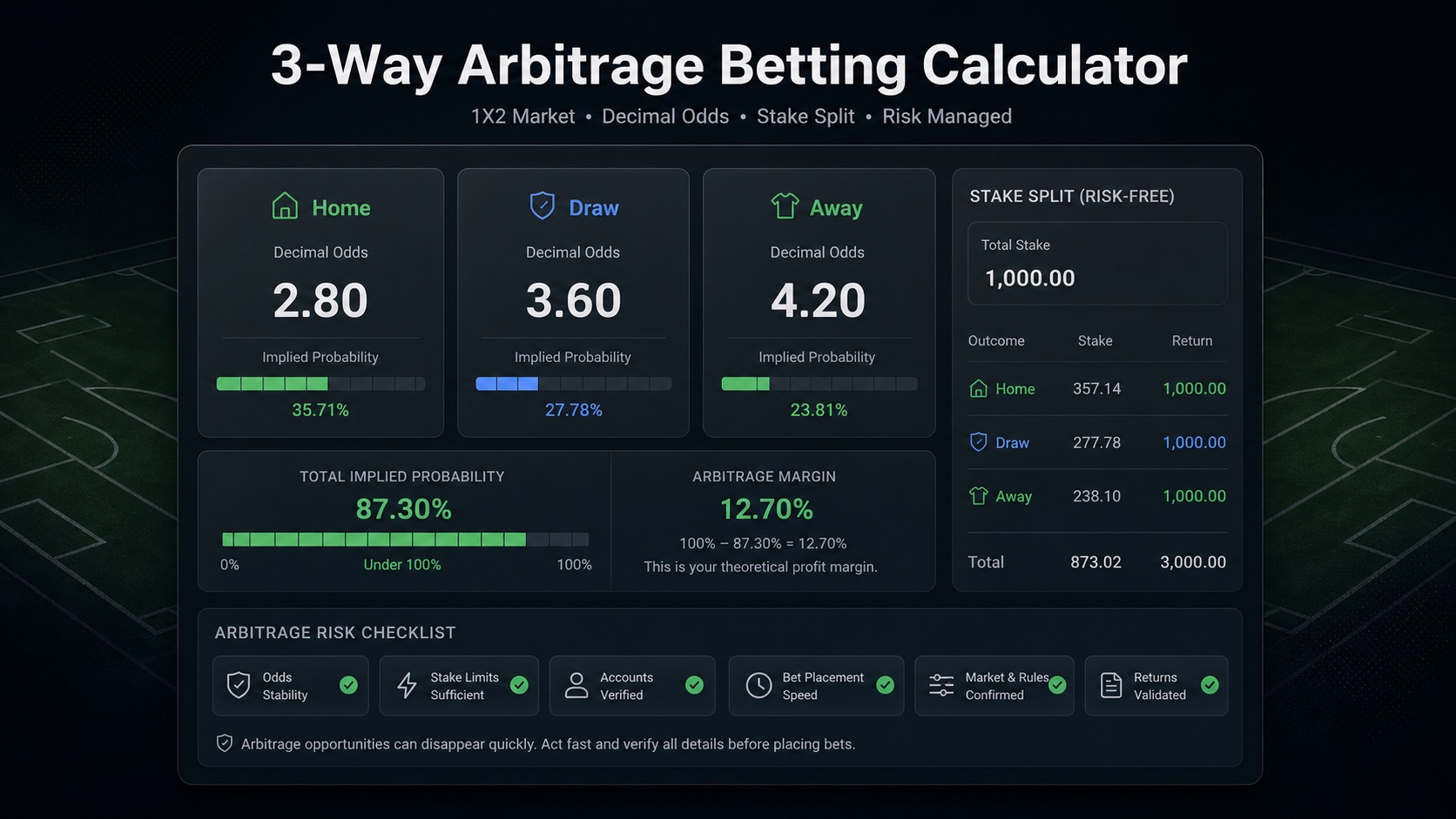
| Home win | 2.80 | 35.71% | Best home price |
| Draw | 3.60 | 27.78% | Best draw price |
| Away win | 4.20 | 23.81% | Best away price |
| Total | 3 outcomes | 87.30% | 12.70% theoretical margin |
The displayed prices add to 87.30%. On paper, that is a huge arbitrage margin. In real markets, margins this large are rare and often signal stale odds, a data mismatch, a market-rule difference, or a price that will not survive submission. Treat oversized arbs as suspicious until the tickets prove otherwise.
3-Way Stake Split Formula
Once the price set passes the under-100% test, calculate stake by target return. Use this formula for each outcome:
Stake for outcome: (total stake / that outcome's decimal odds) / sum of all reciprocal decimal odds
Return if outcome wins: stake on that outcome x decimal odds
Profit: return if covered outcome wins - total stake
Using the example above with a $1,000 total stake:
| Outcome | Decimal odds | Stake | Return if it wins |
|---|---|---|---|
| Home win | 2.80 | $409.05 | $1,145.33 |
| Draw | 3.60 | $318.15 | $1,145.34 |
| Away win | 4.20 | $272.80 | $1,145.76 |
| Net result | Any covered result | $1,000.00 total | About $145 profit before friction |
The longest price gets the smallest stake. That is correct because a smaller bet at a larger payout can still return the same amount as a bigger bet at shorter odds.
Why the Draw Leg Changes the Workflow
In a two-way moneyline, every result usually maps to Side A or Side B. In soccer 1X2, a draw is its own outcome. That means a bettor who only covers home and away has not hedged the market. They have made a directional position against the draw.
The draw also tends to expose mistakes quickly. If one book offers a regulation-time 1X2 market and another screen is showing a two-way "draw no bet" price, the calculator may look profitable because the inputs are not describing the same bet. The same problem can happen with cup matches, extra-time rules, abandoned fixtures, and futures markets with dead-heat terms.
Before placing a 3-way arb, read the market name and house rules on every leg. If the market wording does not match, do not force the numbers into the calculator.
Execution Checklist Before You Place the First Leg
- Confirm all three outcomes are from the same event and market. Same teams, same start time, same regulation-time framing, and no hidden "draw no bet" conversion.
- Refresh the price on every ticket. A 3-way arb can collapse if any one leg moves before confirmation.
- Check max stake before submitting. If the away side only accepts $90 when the calculator needs $272.80, the whole allocation must be recalculated.
- Place the least stable or most constrained leg first. Submit the leg most likely to move, reject, or limit before the more liquid legs.
- Record exact terms immediately. Log book, market name, odds, stake, timestamp, expected return, and rule notes in a bet tracker spreadsheet.
- Stop if one leg fails. Do not automatically chase a replacement price. Recalculate the whole market from the confirmed bets and current odds.
3-Way Arbitrage vs Middle Betting
A 3-way arb covers mutually exclusive outcomes at available prices. A middle betting setup usually bets both sides of a spread or total and hopes the final score lands in the window where both tickets win or avoid full loss. The goals are different.
| Workflow | Main question | Key risk |
|---|---|---|
| 3-way arbitrage | Do home, draw, and away prices total under 100%? | One uncovered or mismatched outcome breaks the position. |
| Middle betting | Is the score window worth the downside cost? | The middle may miss and leave a partial or full loss. |
| Hedging | How much profit or loss should be locked in? | The hedge can give up too much expected value. |
If the market is not a true 1X2 underround, compare the alternatives with the hedge calculator or middle calculator instead of pretending every multi-leg price gap is an arb.
When a 3-Way Arb Is Probably Fake
- The margin is unusually large. A double-digit arb is more likely to be stale, limited, or mismatched than a reliable profit path.
- The draw price comes from a different market type. Soccer has many similar-looking markets with different grading rules.
- One leg is from a promo, boost, or bonus term. Boost restrictions may cap stake, alter payout, or make the bet non-withdrawable.
- One book is slow to settle or verify. Delays can trap bankroll and reduce practical return.
- You cannot place the required stake on every outcome. Partial limits turn balanced profit into directional exposure.
How to Use 3-Way Arb Math Even If You Never Arb
Most bettors should use 3-way arbitrage math as a market-quality check, not a full-time account strategy. The habit is valuable because it forces you to translate every price into implied probability and compare books before deciding that a number is worth betting.
That connects directly to the broader BetResearcher workflow: use line shopping to find the best available price, use the EV calculator to test a fair-probability estimate, then use unit sizing and variance planning so one attractive number does not become reckless exposure.
Audit the Price Before You Chase the Gap
Juice can analyze a bet slip screenshot, compare sportsbook price to fair probability, and give you EV context before you decide whether a number deserves stake.
Download Juice on iOSFAQ
What is a 3-way arbitrage betting calculator?
A 3-way arbitrage betting calculator checks whether the home, draw, and away prices in a market add to less than 100% implied probability, then calculates the stake needed on each outcome to balance the return.
How do you calculate 3-way arbitrage?
Convert the three prices to decimal odds, add 1 divided by each decimal price, and multiply by 100. If the total is below 100%, the prices create a theoretical arbitrage margin.
Can you do 3-way arbitrage with American odds?
Yes, but convert American odds to decimal odds first. Positive American odds convert with odds divided by 100 plus 1. Negative American odds convert with 100 divided by the absolute odds plus 1.
Why is soccer 1X2 arbitrage risky?
Soccer 1X2 arbitrage is risky because the draw must be covered, prices move quickly, and market wording can differ across books. Regulation-time rules, extra time, voids, and abandoned-match policies need to match.
Is 3-way arbitrage betting legal?
Arbitrage is a pricing strategy, but sportsbook terms, local law, account limits, and responsible gambling rules still apply. Avoid prohibited automation, multi-account behavior, and any betting where sports wagering is not legal for you.
Sources
- Pinnacle: arbitrage calculator and implied probability workflow
- Smarkets: how to calculate arbitrage betting
- Smarkets: implied probability from decimal odds
- National Council on Problem Gambling: responsible sports gambling principles
BetResearcher is an independent research site. This guide is educational, not financial advice or a guarantee of profit. Sports betting involves risk, and you should only bet where legal and with money you can afford to lose.