You are crossing a valuable number
The line move changes enough real-world outcomes to justify the price, such as moving through a common football margin.
Alternate lines let you trade a better or worse number for a different payout. The trap is assuming the new payout is fair just because the line feels more comfortable.
Last updated: August 11, 2026
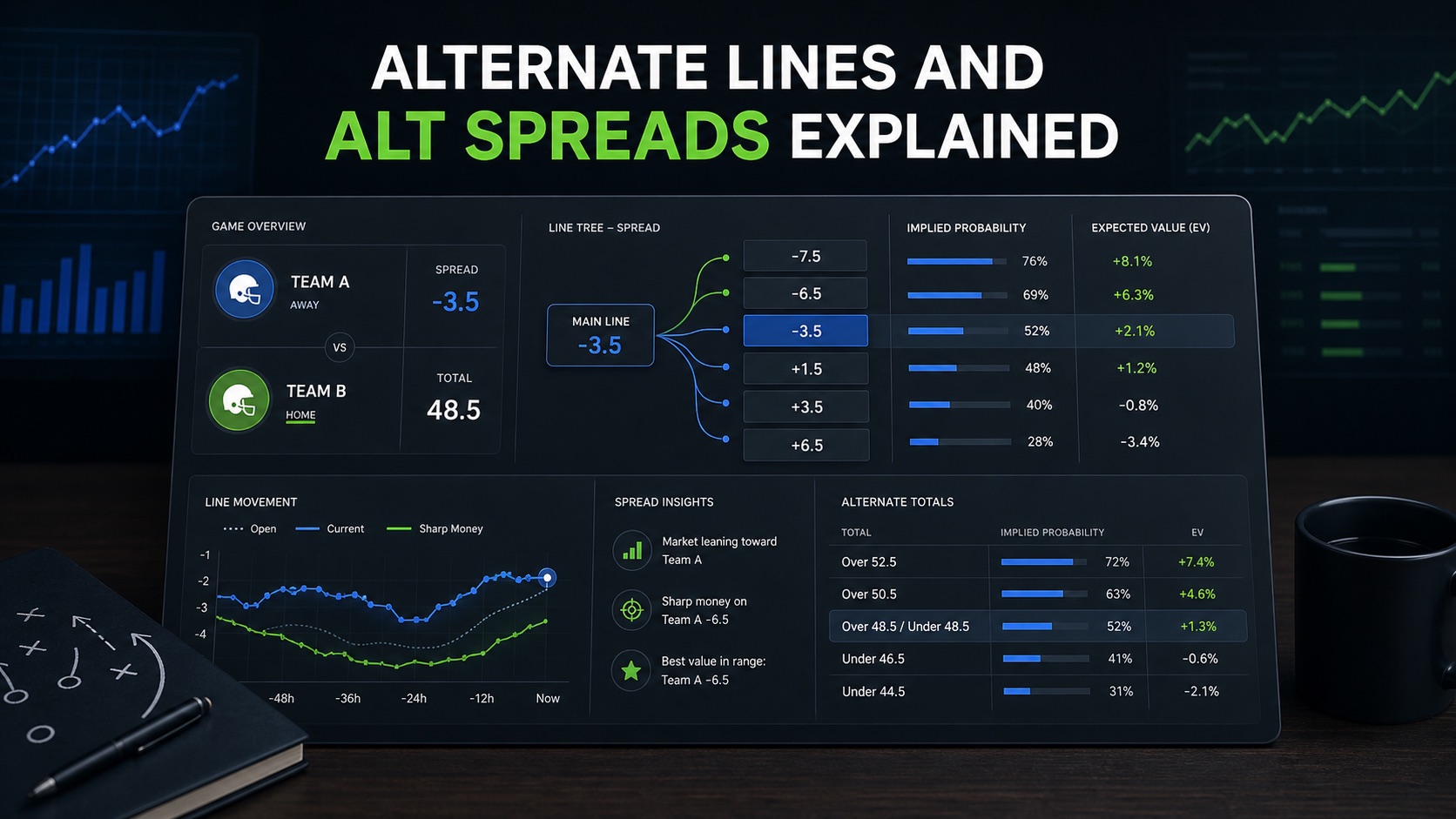
An alternate line is a version of a sportsbook market that uses a different number from the main posted line. If the main NFL spread is Chiefs -6.5, the sportsbook may also offer Chiefs -3.5, Chiefs -10.5, Raiders +3.5, Raiders +10.5, and many prices between those points.
The same idea applies to totals and player props. A basketball game with a main total of 221.5 might have alternate totals at over 215.5, over 229.5, under 214.5, and under 236.5. A player points prop listed at 24.5 may also have 20+, 25+, 30+, or 35+ ladders.
The important part: each alternate line is a separate bet. The sportsbook is not merely letting you customize the ticket. It is repricing the probability of that new outcome.
An alt spread changes the margin the team must cover. You can make a favorite's job easier by laying fewer points, or make it harder in exchange for a bigger payout. You can also make an underdog's cushion bigger for a smaller payout, or smaller for a bigger payout.
| Market choice | Example | What changed | Risk tradeoff |
|---|---|---|---|
| Main spread | Favorite -6.5 at -110 | Standard market number | Usually the most liquid and easiest to compare. |
| Easier favorite alt | Favorite -3.5 at -190 | The favorite can win by fewer points | Higher win rate, but a much higher break-even rate. |
| Harder favorite alt | Favorite -10.5 at +175 | The favorite must win by more | Lower hit rate, larger payout, more variance. |
| Easier underdog alt | Underdog +10.5 at -210 | The underdog gets extra cushion | Comfortable ticket, but expensive insurance. |
| Harder underdog alt | Underdog +3.5 at +160 | The underdog gets less cushion | Better payout, but fewer close-loss outcomes survive. |
Before comparing alt lines, convert the odds to implied probability. If an easier line is priced at -190, the break-even rate is 65.5%. If the main -110 spread breaks even at 52.4%, you are paying a major premium for those extra points.
Positive American odds: 100 / (odds + 100)
Negative American odds: absolute odds / (absolute odds + 100)
Decision rule: bet the alternate line only if your fair probability is higher than the break-even probability after vig.
Use the odds converter when the price format is slowing you down. Once the odds are in probability form, the alt-line decision becomes less emotional: do you really think this outcome happens often enough to clear the sportsbook's price?
Some point-spread moves are more valuable than others because games land on certain margins more often. In football, 3 and 7 are famous key numbers because field goals and touchdowns shape final margins. Moving from +2.5 to +3.5 is not the same as moving from +4.5 to +5.5.
That does not mean every move through a key number is automatically worth the price. Sportsbooks know bettors want those numbers, so the alt-line menu often charges for them aggressively. The right question is not "did I cross 3?" It is "did I cross 3 at a price that still leaves expected value?"
Basketball, baseball run lines, hockey puck lines, and player props have different distribution shapes. A half-point near a common prop line may matter; a half-point far from the median may barely matter. This is why alternate-line betting works better when you understand the market's scoring distribution, not just the surface number.
Alternate totals change the combined score threshold. Bettors use them to reduce risk, take a bigger position on a game script, or build a payout around a more extreme outcome. The same math applies: a lower over is easier and pays less; a higher over is harder and pays more.
Player-prop ladders are the prop version of alternate lines. If a player has a 24.5 points line, alternate prices might list 20+, 25+, 30+, and 35+. The further you climb, the more the bet becomes a distribution question. You are no longer asking whether the player is a good over. You are asking how often they reach a specific tail outcome.
For props, pair the alt-line check with the player props research workflow. Usage, minutes, matchup, injury context, and blowout risk can matter more than the payout shown on the ladder.
Use a simple four-step workflow before betting an alternate spread, total, or prop ladder:
BetResearcher's EV calculator is useful here because it forces you to enter both the sportsbook price and your probability estimate. If you cannot defend the probability, the alternate line is probably just a more interesting-looking ticket.
Alternate-line menus can differ sharply between sportsbooks. One book might price Team A -3.5 at -180 while another offers -165. That looks like a small difference, but the break-even rates are 64.3% and 62.3%. If your fair estimate is 63%, one price is bad and the other may be playable.
That is why alternate lines belong in the same workflow as line shopping and no-vig market checks. Compare books first, then calculate whether the best available number still has an edge. If the market is two-sided and liquid enough, a no-vig odds calculator can help you strip out sportsbook hold before estimating the fair price.
The line move changes enough real-world outcomes to justify the price, such as moving through a common football margin.
Your research says the market is not just wrong on the side, but wrong about the shape of possible outcomes.
One sportsbook's alt-line menu is stale or softer than the broader market after you compare prices.
Alternate lines are weakest when they are used as emotional insurance. Paying -220 because you are afraid of a backdoor cover may feel safer, but it can turn a reasonable opinion into a negative-EV bet.
Alternate-line bets deserve controlled stake sizing because the edge estimate is often less certain than the main spread or total. Even if you like the bet, the probability model has to be more precise: it must estimate how often a team wins by 4 instead of 7, or how often a player reaches 30 instead of 25.
For most bettors, the clean default is a small fixed unit. Start with the sports betting unit size calculator, then use a flat betting strategy unless you have a tested edge and a large enough sample to justify fractional Kelly. If you do use Kelly, consider quarter Kelly rather than full Kelly because alt-line probability errors can be expensive.
Use Juice to analyze a bet slip screenshot, compare price and probability, and decide whether the alternate line is actually worth the payout.
Download Juice on iOSAn alternate line is a sportsbook price on a spread, total, or prop that differs from the main market number. You can take an easier or harder number, but the odds change to compensate.
Only when the adjusted line and price create more expected value than the regular spread. A safer-looking line can still be overpriced.
The sportsbook changes the payout because the chance of winning changes. Easier lines usually pay less, while harder lines usually pay more.
Most bettors should size alternate-line bets smaller than standard main-market bets unless they can defend the fair probability. When in doubt, use a fixed unit and avoid increasing stake just because the payout is tempting.