How to Find Positive EV Bets: A Repeatable Workflow
Positive EV betting is not a magic list of picks. It is a price-checking process: estimate fair probability, compare the best available odds, calculate expected value, and only bet when the edge survives review.
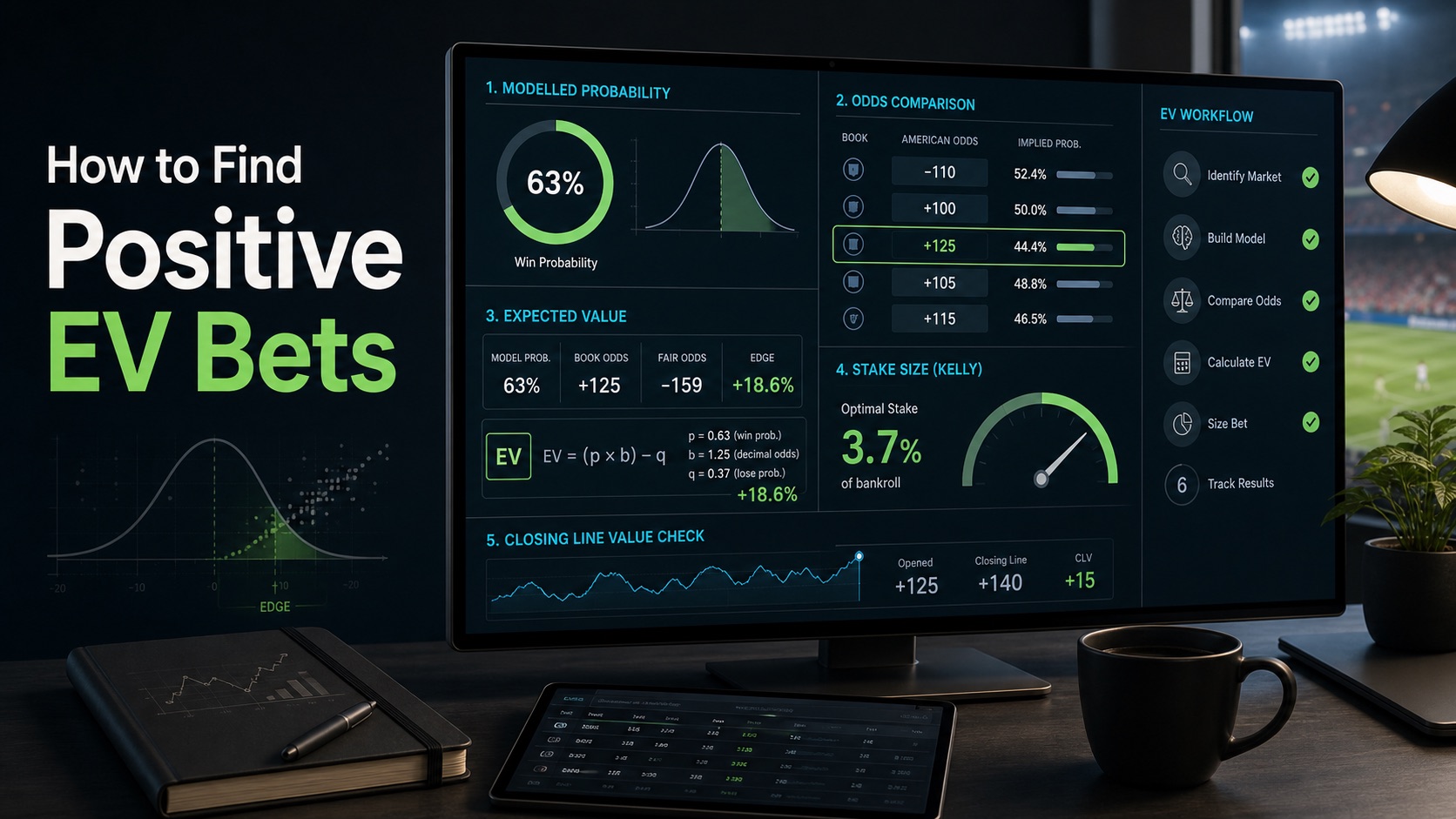
Key takeaways
- Positive EV is a price problem. The same pick can be good at +125, marginal at +105, and unplayable at -110.
- Your probability estimate is the fragile input. If the model, source, or assumption behind that estimate is weak, the EV result is weak too.
- Line shopping comes before staking. Use the best legal, bettable price you can actually place, not a stale screenshot or average line.
- Stake size should shrink for uncertainty. Full Kelly is too aggressive for most sports betting estimates; fractional Kelly or flat staking is easier to survive.
- CLV is the review signal. A positive EV workflow should produce bets that often beat the closing price, even though individual bets still lose.
What is a positive EV bet?
A positive EV bet is a wager where the expected payout is greater than the amount risked after you compare your fair probability to the sportsbook price. In plain English: you believe the bet wins often enough that the offered odds are too generous.
Expected value is not a guarantee. It is an average-outcome concept. A +EV moneyline can lose tonight, and a bad bet can win by accident. The point is to repeat decisions where the price is better than the true risk.
The positive EV formula
For a one-unit bet, use this version:
If a bet pays +125, a 1-unit stake wins 1.25 units of profit. If your fair win probability is 47%, the loss probability is 53%.
| Input | Value | Why it matters |
|---|---|---|
| Sportsbook odds | +125 | The offered payout is 1.25 units of profit per unit risked. |
| Your fair probability | 47% | Your estimate says the outcome wins 47 times per 100 similar bets. |
| Break-even probability | 44.44% | The +125 price only needs 44.44% to break even before other costs. |
| Expected value | +5.75% | (0.47 x 1.25) - (0.53 x 1.00) = +0.0575 units. |
You can run the same math in the BetResearcher EV calculator. If you need to translate American, decimal, or fractional prices first, use the odds converter.
Step 1: Convert the sportsbook price
Start by turning the sportsbook odds into break-even probability. The price tells you the win rate a bet needs before it can become profitable. For positive American odds, divide 100 by odds plus 100. For negative American odds, divide the absolute odds by absolute odds plus 100.
| Odds | Break-even probability | Plain meaning |
|---|---|---|
| +150 | 40.00% | The bet needs to win more than 40% of the time. |
| +125 | 44.44% | The bet needs to win more than 44.44% of the time. |
| -110 | 52.38% | The bet needs to win more than 52.38% of the time. |
| -150 | 60.00% | The bet needs to win more than 60% of the time. |
Implied probability calculators, including OddsJam's public calculator, use the same basic conversion idea: odds can be expressed as the percentage chance implied by the price. That number includes sportsbook margin, so it is a hurdle, not a clean estimate of true probability.
Step 2: Estimate a fair probability
This is where most +EV claims break. A fair probability estimate should come from a repeatable process, not a feeling that a team is "due." Depending on the market, that process might include projections, injury status, starting lineups, pace, weather, bullpen usage, matchup data, market history, or no-vig consensus.
Do not let a model number float without context. Ask where it came from, how recently it updated, whether it includes the current lineup, and whether it is calibrated against closing prices. If you are using AI, treat it as a research assistant, not an oracle. The AI sports betting research guide explains how to keep model output auditable.
Step 3: Remove vig or find a market baseline
A sportsbook price is not a pure probability estimate because sportsbooks build margin into markets. For two-way markets, you can convert both sides into implied probability, add them, and normalize back to 100% to estimate a no-vig baseline.
That no-vig baseline is not automatically truth, but it is a useful anchor. If your model says an outcome is 55% and the market baseline is 46%, you need a strong reason. If your model says 47% and the no-vig market is 45%, the disagreement is more plausible. Use the no-vig odds calculator guide before trusting a big edge number.
Step 4: Shop the actual line
Positive EV is always attached to a specific price. If a screen shows +125 but your sportsbook only offers +110, the EV changed. If a prop moved from over 24.5 to over 25.5, you are no longer comparing the same bet.
A strong workflow checks every legal book you can responsibly access, then stores the best current bettable number. Odds screens and line-shopping tools make this faster, but the rule is the same manually: compare the exact market, exact side, exact line, and exact price. The line shopping guide gives the full checklist.
Step 5: Calculate edge and decide if it is large enough
Small positive EV is easy to erase with stale data, model error, limits, or a bad line comparison. For recreational bettors, a practical filter is to require enough edge that the bet still looks playable after you haircut the probability estimate.
| Model edge | How to treat it | Practical decision |
|---|---|---|
| 0% to 1% | Noise zone | Pass unless you have a very strong market reason. |
| 1% to 3% | Thin edge | Shop harder, reduce stake, and verify assumptions. |
| 3% to 7% | Playable candidate | Run EV, confirm market, then size conservatively. |
| 7%+ | Red-flag zone | Check stale odds, injury news, model bugs, and market mismatch before betting. |
Big edges do exist, especially on soft props, promos, boosts, and stale markets. But the larger the claimed edge, the more aggressively you should audit it.
Step 6: Size the stake without pretending the model is perfect
The Kelly Criterion connects edge, odds, and bankroll into a bet-size formula. Kelly's original 1956 paper framed the criterion around maximizing long-run growth under known probabilities. Sports bettors almost never know probabilities perfectly, which is why fractional Kelly and flat betting are more practical.
Use the Kelly calculator for the math, then reduce the output with a cap. Quarter Kelly, half Kelly, or a flat 0.5% to 1% bankroll unit is usually more survivable than betting the full theoretical result. The quarter Kelly guide, flat betting strategy guide, and unit size calculator guide cover those guardrails.
Step 7: Track the closing line
Results are noisy. Closing line value is cleaner. If you bet +125 and the market closes +110, your process found a better price than later bettors could get. If you keep betting +125 numbers that close +140, your process may be catching bad prices even when individual tickets win.
CLV is not perfect, especially on niche props and inefficient markets, but it is a useful audit trail. Log opening price, bet price, close price, model probability, stake, and result. Then review the process by market type, not just by whether last night's bet cashed. Start with the closing line value guide.
Positive EV workflow checklist
- Define the exact market. Sport, event, market, side, line, odds, book, and timestamp.
- Convert the odds. Record break-even probability before you look for confirmation.
- Estimate fair probability. Use projections, market baselines, injury context, and matchup data.
- Remove vig when possible. Compare your number to a no-vig market estimate.
- Shop the line. Use the best live price you can actually bet.
- Run EV. Pass only when the edge survives conservative assumptions.
- Size the stake. Use fractional Kelly, flat units, or a hard risk cap.
- Review CLV. Track whether your prices beat the market close over time.
Tools that help find positive EV bets
The right tool depends on where your process is weakest. If you need market-wide scans, compare dedicated +EV and odds-screen products. If you need to understand one bet slip, use an EV calculator or AI slip analyzer. If you need discipline, use a bet tracker and bankroll calculator.
Odds screens
Useful for spotting price gaps, stale numbers, and books with the best current line.
No-vig calculators
Useful for translating a market into fair baseline probability before adding your opinion.
EV calculators
Useful for checking whether your probability estimate clears the sportsbook hurdle.
Bet trackers
Useful for reviewing CLV, bankroll exposure, market type, and process quality.
BetResearcher keeps a sports betting tools directory and a dedicated best positive EV betting tools comparison. For app-first workflows, also read the positive EV betting app guide and EV betting tools guide.
Common mistakes
- Calling every disagreement with the book an edge. Your probability estimate needs a reason to beat the market.
- Using the wrong price. EV must use the live, bettable odds available to you.
- Ignoring limits and account friction. A theoretical edge is less useful if you cannot stake or withdraw cleanly.
- Overfitting player props. Small samples, role changes, and matchup narratives can make props look cleaner than they are.
- Scaling up after a short hot streak. Positive EV still comes with losing runs.
Responsible +EV betting
Positive expected value is still gambling. The American Gaming Association's responsible sports betting principles emphasize budget-setting, legal operators, informed decisions, and keeping betting social. The National Council on Problem Gambling highlights limit-setting and responsible play resources for sports betting.
That fits a serious EV workflow. Set the bankroll before the slate, decide the max unit size before seeing a pick, and never treat a model edge as permission to bet money you cannot afford to lose.
FAQ
What is a positive EV bet?
A positive EV bet is a wager where your fair win probability is higher than the break-even probability implied by the sportsbook price after accounting for payout.
How do you find positive EV bets?
Find positive EV bets by estimating a fair probability, comparing it with the best available sportsbook price, calculating expected value, checking the market context, and sizing the stake conservatively.
Is a positive EV bet guaranteed to win?
No. Positive EV describes the average value of a price over many similar bets. Any single bet can still lose.
What tools help find positive EV bets?
Useful tools include odds screens, no-vig calculators, EV calculators, bet trackers, line-shopping apps, and AI bet slip analyzers that let bettors audit the probability and price assumptions.
Sources and references
- OddsJam: Expected Value Calculator
- OddsJam: Implied Probability Calculator
- J. L. Kelly Jr.: A New Interpretation of Information Rate
- American Gaming Association: Responsible sports betting principles
- National Council on Problem Gambling: Responsible sports gambling principles
Next steps
Start with one candidate bet. Convert the price with the odds converter, calculate the edge with the EV calculator, and compare tools in the positive EV betting tools guide. If the bet still looks good after line shopping and stake sizing, log it and review the closing line later.