Kelly Criterion Examples for Sports Betting
Kelly Criterion examples are useful only when they connect the formula to real betting decisions: price, probability, bankroll, model error, and the choice to pass.
Last updated: September 5, 2026
Key Takeaways
- Kelly sizing starts after the EV check. If a bet does not clear break-even probability, the correct Kelly output is pass.
- Full Kelly is fragile in sports betting. John Kelly's original growth framework assumes useful probability information; noisy sports probabilities make half Kelly or quarter Kelly more realistic.
- Plus-money bets can produce surprisingly large stakes. That does not mean the edge is more certain; it means the payout ratio is doing more work.
- Favorites need clean probability estimates. Expensive prices leave less room for error once vig and break-even rate are included.
- Caps still matter. A sports betting unit size rule can keep a mathematically positive bet from becoming too large for your bankroll.
The Kelly Formula in Betting Terms
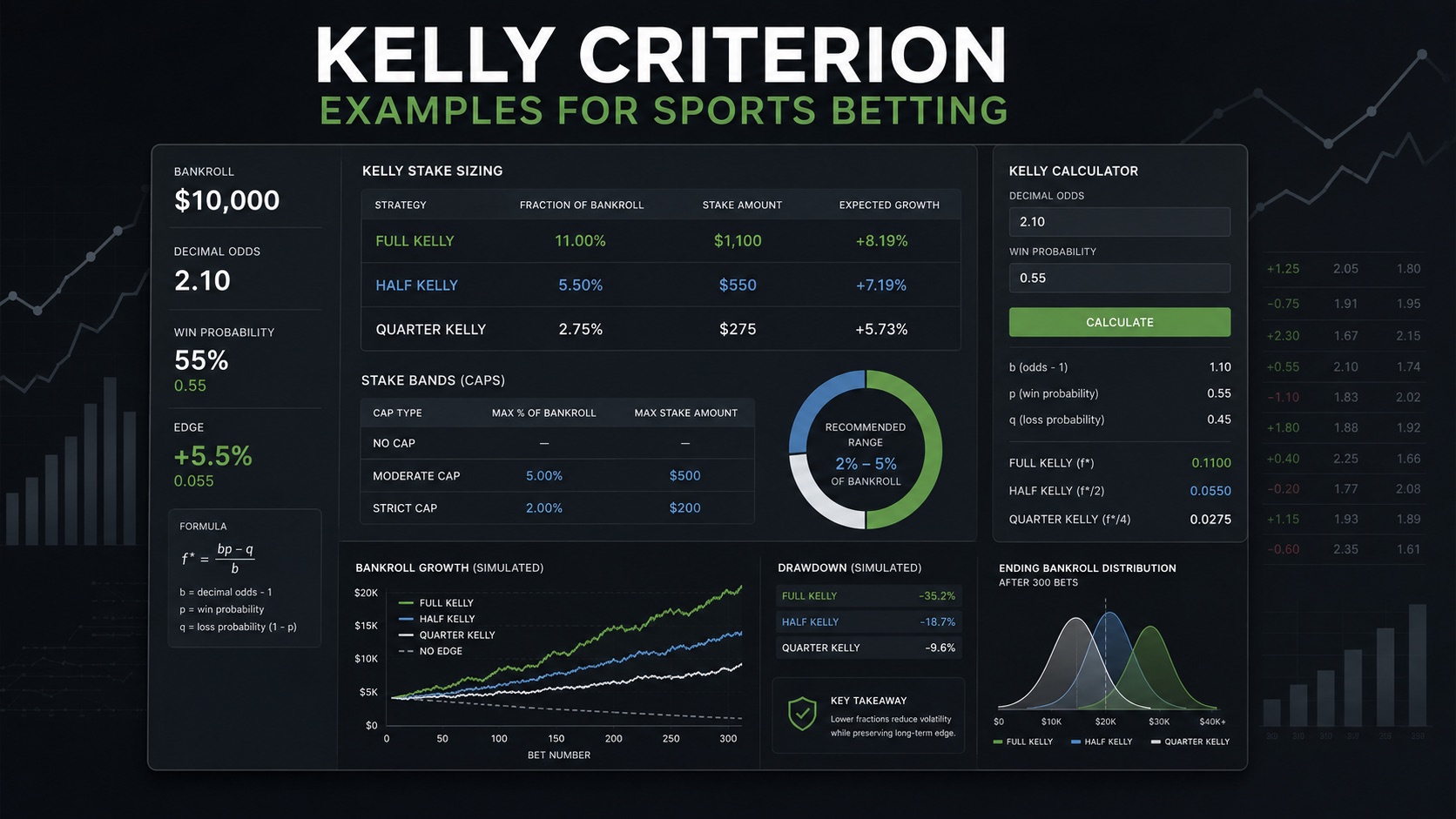
The common two-outcome Kelly formula is:
Kelly fraction: (b x p - q) / b
b: decimal odds minus 1
p: your estimated probability of winning
q: 1 - p, or your estimated probability of losing
Kelly's 1956 paper connected betting size to long-run growth when the bettor has favorable information. Edward Thorp later popularized practical Kelly thinking in gambling and markets. Sports betting adds a harder input problem: your probability estimate is rarely known with the precision the formula seems to imply.
That is why this guide treats the Kelly Criterion calculator as a sizing tool, not a pick generator. The order should be: convert the odds, estimate fair probability, check expected value, then use Kelly to decide whether the stake is small, capped, or skipped.
Example 1: A -110 Spread with a 55% Win Estimate
Suppose you have a $1,000 bankroll and believe a -110 point spread wins 55% of the time.
| Input | Value | Why it matters |
|---|---|---|
| Bankroll | $1,000 | The stake is calculated as a percentage of current bankroll. |
| American odds | -110 | Decimal odds are about 1.9091. |
| Win probability | 55% | Your estimate is above the 52.38% break-even rate. |
| Full Kelly | 7.25% | About $72.50 on a $1,000 bankroll. |
| Half Kelly | 3.63% | About $36.30. |
| Quarter Kelly | 1.81% | About $18.10. |
The full Kelly number looks aggressive because a three-point edge over break-even is meaningful at -110. The practical question is whether your 55% estimate is truly defendable. If it came from a calibrated model with a long tracked sample, half Kelly might be reasonable. If it came from a subjective lean, a one-unit flat bet or quarter Kelly is more honest.
Example 2: A Plus-Money Underdog at +140
Now assume a bettor has a $2,500 bankroll, finds +140 on an underdog, and estimates the true win probability at 45%.
| Metric | Calculation | Result |
|---|---|---|
| Decimal odds | +140 converts to 2.40 | b = 1.40 |
| Break-even probability | 100 / (140 + 100) | 41.67% |
| Full Kelly | ((1.40 x 0.45) - 0.55) / 1.40 | 5.71% |
| Full Kelly stake | $2,500 x 5.71% | $142.75 |
| Quarter Kelly stake | $142.75 x 25% | $35.69 |
Plus-money examples are where bettors often get reckless. The payout looks attractive, and the formula rewards the gap between your fair probability and the sportsbook's price. But a 45% estimate on an underdog still needs evidence: injury timing, lineup strength, market movement, matchup fit, and comparable prices across books.
Example 3: A Favorite at -180
Favorites make Kelly feel boring until the probability estimate is very strong. Say a bettor has a $1,500 bankroll, sees -180, and estimates the favorite wins 68% of the time.
| Metric | Value | Readout |
|---|---|---|
| Break-even probability | 64.29% | The price already demands a high hit rate. |
| Estimated edge | 68% - 64.29% | 3.71 percentage points. |
| Full Kelly | 10.40% | About $156 on $1,500. |
| Half Kelly | 5.20% | About $78. |
| Risk check | High price sensitivity | A small probability error can erase the edge. |
The full Kelly number can look large because the bettor believes the favorite wins often enough to overcome the expensive price. That is exactly where model error matters. If the true probability is 65% instead of 68%, the bet is barely above break-even. If the fair probability is 63%, it is negative EV.
Example 4: A Player Prop at +105
Player props can be attractive because the market is less efficient than major sides and totals. They can also be dangerous because limits, injury news, role volatility, and correlation can change quickly.
| Input | Value | Practical adjustment |
|---|---|---|
| Bankroll | $800 | Smaller bankrolls need tighter unit caps. |
| Odds | +105 | Decimal odds 2.05; break-even 48.78%. |
| Estimated probability | 52% | Small but positive edge if the estimate is sound. |
| Full Kelly | 6.29% | About $50.30. |
| Quarter Kelly | 1.57% | About $12.58. |
| Suggested cap | 1% to 1.5% | Props deserve extra model-error protection. |
This is where the player props research checklist and an AI player prop research workflow help. If the probability estimate depends on stale usage, an uncertain injury report, or a single trend split, the Kelly output should be reduced or ignored.
Example 5: The Correct Kelly Stake Is Zero
Kelly is just as useful when it tells you not to bet. Suppose a bettor estimates a -120 moneyline at 53%.
| Check | Value | Decision |
|---|---|---|
| Price | -120 | Break-even probability is 54.55%. |
| Your estimate | 53% | Below break-even. |
| Expected value | Negative | The price is not good enough. |
| Kelly result | Negative fraction | Stake $0. |
A negative Kelly number is not a suggestion to bet smaller. It is a pass signal. If you still like the side, the next move is to line shop. A better price can change the decision. The line shopping workflow and vig calculator guide explain why the bettable number matters more than the opinion.
Full Kelly vs Half Kelly vs Quarter Kelly Examples
The fraction you choose should reflect confidence in the probability estimate, not confidence in the team. A bettor with a tested model, clean closing-line history, and large sample can justify more Kelly exposure than someone reading one injury angle before kickoff.
| Kelly fraction | Stake from a 6% full Kelly output | Best fit | Main risk |
|---|---|---|---|
| Full Kelly | 6.00% of bankroll | Highly calibrated repeatable edges | Severe drawdowns when inputs are wrong |
| Half Kelly | 3.00% of bankroll | Serious bettors with tracked probability work | Still large for thin or correlated edges |
| Quarter Kelly | 1.50% of bankroll | Noisy sports markets, props, emerging models | Slower growth if the edge is genuinely strong |
| Flat unit cap | Usually 0.5% to 2.0% | Beginners or subjective handicappers | May underbet the rare very strong edge |
If you are still building a tracked record, use fractional Kelly as a ceiling. A simple rule works well: calculate quarter Kelly, then cap any single bet at your normal unit size unless you have a documented reason to go higher.
A Practical Kelly Workflow
- Convert the odds. Use an odds converter so the price and implied probability are clear.
- Remove market tax when needed. For two-sided markets, use a no-vig odds calculator to understand the market's fair baseline.
- Estimate your probability independently. Do not copy the sportsbook's implied probability and call it an edge.
- Run EV first. A positive expected-value betting workflow should come before stake sizing.
- Calculate full Kelly. Treat it as the theoretical maximum, not the default stake.
- Cut and cap. Apply half Kelly, quarter Kelly, or a fixed unit cap based on uncertainty.
- Track the result. Log odds, stake, closing line, model probability, and notes in a bet tracker spreadsheet.
Common Mistakes in Kelly Examples
- Using the formula before confirming EV. Kelly cannot rescue a negative-price bet.
- Confusing confidence with probability. Feeling strong about a side is not the same as estimating it at 55%.
- Ignoring vig. The sportsbook's hold raises the hurdle and can make a small edge disappear.
- Overbetting correlated positions. Five props from the same game script are not five independent Kelly opportunities.
- Keeping bankroll static after losses. Kelly stakes should be based on current bankroll, not the peak number you wish you still had.
- Skipping responsible limits. Bankroll math is not a reason to bet money needed elsewhere.
Sources and Further Reading
- John L. Kelly Jr., A New Interpretation of Information Rate, Bell System Technical Journal, July 1956.
- Edward O. Thorp, The Kelly Criterion in Blackjack, Sports Betting, and the Stock Market.
- National Council on Problem Gambling, problem gambling resources and helpline information.
Bottom Line
Kelly examples are best used as a discipline drill. If the bet is not positive EV, stake zero. If the edge is real but uncertain, use fractional Kelly or a fixed unit cap. If the full Kelly number shocks you, that is not a bug. It is the formula reminding you to inspect the probability estimate before the stake gets dangerous.
Run the stake before you bet
Use BetResearcher's Kelly calculator to compare full, half, and quarter Kelly against your bankroll and sportsbook odds.
Open Kelly calculator