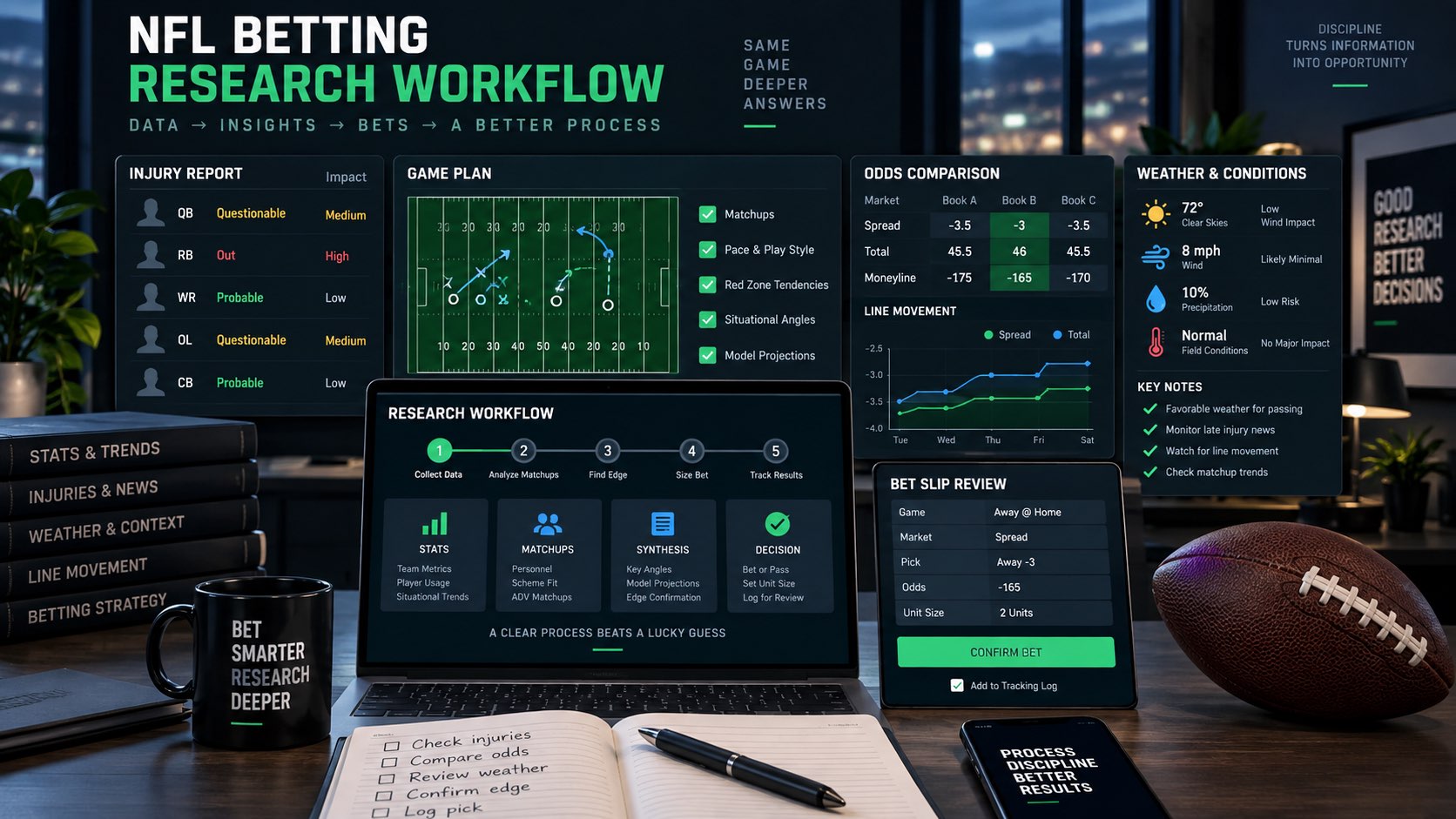
The best NFL betting research workflow is not a list of picks. It is an operating system for deciding which bets deserve attention, which bets deserve a pass, and which lines moved before you were ready. NFL markets are noisy because one roster update, weather shift, or line move can change a spread, total, player prop, same-game parlay, or live-betting setup.
This guide is built for bettors comparing an NFL betting research app, an odds screen, a prop research tool, or a manual spreadsheet process. Use it as a weekly sequence: collect the inputs, translate the odds, test the bet for expected value, size the wager, and log what happened.
The NFL betting research workflow
Check injury reports, inactive news, and position-group depth before touching odds.
Study pass rush, coverage, run defense, pace, red-zone style, and likely game script.
Review weather, surface, rest, travel, and schedule context.
Compare sportsbook lines, track movement, and convert odds into implied probability.
Compare your fair estimate to the current price, then run an EV check.
Set unit size, cap exposure, log the bet, and review closing line value later.
1. Check NFL injuries before matchup opinions
Availability is the first filter because every other NFL assumption depends on who is actually likely to play. A wide receiver prop changes when the starting quarterback is limited. A rushing prop changes when two offensive linemen are out. A total changes when both starting corners are missing or when the weather makes deep passing harder.
The NFL's public reporting cadence gives bettors a useful research rhythm. The league's operations calendar says clubs file regular-season Game Status Reports on set deadlines by kickoff day, including Friday for Sunday games and Saturday for Monday games. The same source also notes that estimated practice reports are not acceptable on days when a team actually practices. That matters because a real limited practice is more useful than a vague news blurb.
| Input | What to check | Betting implication |
|---|---|---|
| Quarterback status | Practice participation, game designation, backup quality, offensive style change | Spread, total, receiver props, sack props, turnover props |
| Offensive line injuries | Tackle availability, center changes, pass-protection mismatch | QB pressure, rush efficiency, unders, sacks, turnover risk |
| Corner and safety injuries | Coverage depth, slot matchup, safety help, replacement experience | Receiver props, explosive-pass risk, team totals |
| Running back room | Lead-back role, pass-down role, short-yardage role, snap split | Rushing props, reception props, anytime TD markets |
2. Turn matchup notes into a market question
A matchup note is not a bet by itself. "Team A struggles against the run" becomes useful only when it connects to a price: Does the spread already reflect it? Is the rushing prop too high? Did the market move before you saw the angle? Can the opponent actually stay on schedule long enough to run?
For NFL sides and totals, focus on the matchup variables that most directly change scoring and possession quality: pressure rate, offensive line health, explosive plays, red-zone efficiency, pace, turnover volatility, and whether one team's strength forces the opponent away from its preferred plan.
For player props, work from role to price. The right sequence is target or carry expectation, matchup, game script, sportsbook line, alternate prices, then EV. The broader player props research checklist covers the same idea across sports; NFL props simply punish role mistakes faster because volume can collapse when game script flips.
3. Add weather only when it changes football
Weather is easy to overuse and dangerous to ignore. Light rain is often less important than wind. Temperature is often less important than field conditions. A dome game may need no weather adjustment at all, while an outdoor game with strong wind can change pass depth, kicking confidence, and total sensitivity.
Use an official or primary forecast source first. NOAA describes the National Weather Service as the agency that provides weather, hydrologic, and climate forecasts and warnings for the United States. For NFL betting, the practical check is simple: wind direction and speed, gusts, precipitation, temperature, and any stadium-specific context.
4. Compare odds before calculating confidence
Once the football context is set, switch to price. Use a sports betting odds scanner app or manual line-shopping routine to compare the same market across books. A bet can move from pass to playable when a different sportsbook offers a better number.
Translate each price into implied probability with the odds converter. Then remove market noise with the no-vig odds calculator when you are comparing both sides of a market. The goal is to separate the sportsbook's price from your estimate of the actual event probability.
5. Run the EV check before the stake decision
Expected value is where the workflow becomes disciplined. If your fair probability does not beat the break-even rate, the bet should usually be a pass no matter how much you like the football angle. If it does beat the break-even rate, run the actual value with an EV calculator before deciding how much to risk.
| Research result | Workflow decision | Next page |
|---|---|---|
| Fair estimate is below break-even | Pass or wait for a better number | Break-even odds |
| Fair estimate clears break-even | Calculate EV and compare book prices again | EV examples |
| Edge is real but estimate is fragile | Reduce stake or skip the bet | Unit size calculator |
| Market moves against you | Review whether the original thesis is stale | CLV tracker |
6. Match the tool stack to the NFL bet type
There is no single best NFL betting software stack for every bettor. The right stack depends on the bet you are researching. A Sunday spread bettor needs market screens and injury alerts. A prop bettor needs player role, projections, alternate lines, and news. A parlay bettor needs leg-by-leg review and correlation checks.
Use odds screens, injury reports, weather, no-vig baselines, and CLV tracking.
Use prop research apps, role data, injury replacements, sportsbook comparison, and EV checks.
Use a parlay analyzer app, correlation checks, bet slip review, and smaller stake sizes.
If you want a broader buying framework, start with best sports betting software, then compare the category map in the sports betting research app market map. If your workflow starts with a sportsbook screenshot, the bet slip scanner apps guide is the more direct path.
Example NFL pre-bet checklist
Use this as a quick order-of-operations check before an NFL bet reaches the slip:
- Confirm the game, market, line, book, and odds.
- Check official injury status and credible beat-reporter context.
- Review matchup fit: pressure, coverage, run defense, pace, red zone, and explosive plays.
- Check weather if the game is outdoors.
- Compare prices across sportsbooks and note line movement.
- Convert the offered odds to break-even probability.
- Estimate fair probability from the football case, not from the payout.
- Calculate EV and decide whether the edge survives the vig.
- Size the bet using a fixed-unit, fractional Kelly, or capped-risk rule.
- Log the ticket, closing price, result, and process notes.
Common NFL workflow mistakes
Starting with consensus picks. Consensus can tell you what other people are saying, but it does not tell you whether the current price is good.
Ignoring late inactives. NFL inactive lists near kickoff can change depth-chart assumptions quickly. Treat a questionable player as unresolved until the final context is clear.
Using one sportsbook price. A single book price is not the market. Line shopping is often the easiest edge available to non-professional bettors.
Over-staking small edges. NFL edges are noisy. Use a bankroll calculator example or Kelly calculator only after you have a probability estimate you can defend.
FAQ
What is the best NFL betting research app?
The best app depends on workflow. For odds and market-wide price comparison, look for odds screens and +EV tools. For props, prioritize role, projections, injuries, and book comparison. For screenshot-based review, use a bet slip scanner or AI analysis app that helps audit odds, implied probability, EV, and risk before placement.
How early should you research NFL bets?
Start early enough to understand the opening market, but do not finalize every bet before injury and weather information matures. A good NFL workflow has two passes: early market scan, then late confirmation after game status and line movement are clearer.
Should you bet NFL picks from AI?
Use AI as a research assistant, not an automatic pick engine. It can help summarize injuries, compare factors, structure a checklist, and audit a slip, but the bettor still needs to verify sources, price, fair probability, and bankroll fit.
Sources
- NFL Football Operations: important dates and injury reporting deadlines
- NFL.com: official injury report hub
- NFL Football Operations: performance tracking data and Next Gen Stats context
- NOAA: National Weather Service forecast and warning role
Turn the NFL checklist into a slip review.
Use Juice or your own tracker to scan the bet, compare the price, estimate EV, size the stake, and log the result before kickoff.