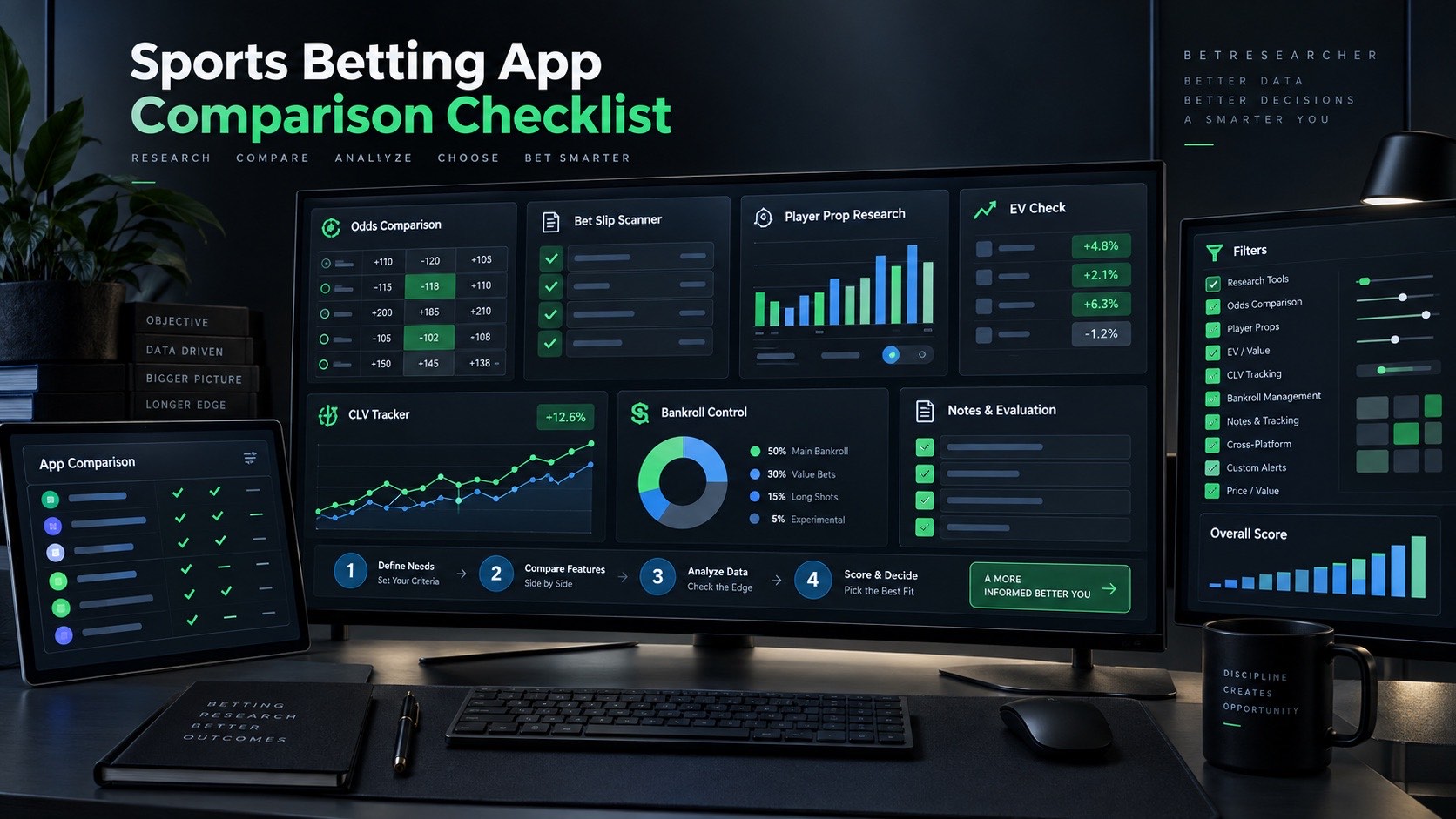
Most sports betting app comparisons collapse too many categories into one list. An odds screen, a bet slip scanner, a prop database, a model app, and a tracker can all be useful, but they are not substitutes for each other. The expensive mistake is paying for a tool because it looks powerful, then realizing it does not match the actual research job.
This checklist is a workflow-first way to compare betting research apps. Use it alongside the best sports betting research apps page, the sports betting research app market map, and the sports betting software stack guide when you are deciding what belongs in your own setup.
Quick answer: the best sports betting app for you is the one that improves the weakest part of your process: finding prices, checking fair probability, researching props, auditing a slip, sizing the bet, or tracking results. Do not pay for discovery software if your real leak is record keeping.
1. Identify The Research Job
Start by naming the job in plain language. If you cannot describe the task, every app demo will look useful. Sports betting software usually falls into one of six jobs:
Odds comparison, line shopping, stale-line alerts, arbitrage, middles, and market screens.
Fair probability, no-vig price, expected value, model estimates, and break-even checks.
Props, injuries, usage, matchups, weather, pace, projections, and context notes.
Screenshot parsing, weak-leg flags, parlay correlation, odds quality, and bankroll exposure.
ROI, closing line value, bet tags, sport splits, book splits, and exportable records.
Unit size, stake caps, bankroll drawdown, Kelly fraction, and responsible betting limits.
For example, a bettor focused on Sunday NFL sides may need injury/weather checks, a clean odds screen, an EV calculator, and a tracker. A player-prop bettor may care more about usage, line movement, alternate markets, and a player prop research workflow. A bettor already holding a screenshot should start with a bet slip review workflow, not another generic ranking page.
2. Score The App Against The Checklist
Use this table before subscribing. A tool does not need to win every row. It needs to win the rows that match your workflow.
| Checklist item | What to inspect | Why it matters |
|---|---|---|
| Workflow fit | Odds screen, prop research, AI analysis, tracker, calculator, content app, or hybrid. | Prevents buying an impressive tool that solves the wrong problem. |
| Sportsbook coverage | Books, states, leagues, market types, props, alternates, live odds, and refresh frequency. | A better app is useless if it misses the books or markets you actually bet. |
| Price freshness | Refresh speed, stale-line warnings, timestamp visibility, odds history, and alerts. | EV can disappear quickly when the app shows an old number. |
| Fair-price method | No-vig market price, model probability, consensus line, projection, or user-entered probability. | You need to know whether the edge comes from market math or a predictive model. |
| Prop depth | Usage, splits, matchup filters, injuries, minutes, weather, game script, alt lines, and historical distribution. | Prop tools should explain why a line is vulnerable, not just display past averages. |
| Slip review | Screenshot import, leg parsing, odds translation, parlay risk, correlation, duplicate exposure, and weak-leg flags. | Many bad bets are not bad ideas. They are bad prices or badly combined legs. |
| Tracking | Book sync, manual entry, CLV, ROI, tags, notes, export, settled bet reconciliation, and bankroll graph. | Without tracking, you cannot separate process quality from variance. |
| Bankroll controls | Unit sizing, stake suggestions, exposure caps, Kelly options, loss limits, and no-bet prompts. | Software that finds edges but encourages oversized bets can still damage bankroll. |
| Privacy and security | Account linking, data export, deletion path, privacy policy, security claims, third-party sync, and app permissions. | Betting records, sportsbook accounts, and payment-related metadata deserve extra caution. |
| Pricing clarity | Trial length, monthly price, annual discount, cancellation path, feature gates, refund policy, and state restrictions. | Subscription economics matter. The app has to clear its own break-even point. |
3. Match App Category To Bettor Type
The fastest comparison is category-to-user fit. This is where a checklist beats a generic "best app" list.
Start with free calculators, odds comparison, education, and a simple bet tracker spreadsheet. Do not buy a high-priced scanner before you know your volume.
Prioritize player data, matchup filters, injuries, usage, odds movement, and prop-specific line shopping before broad market tools.
Prioritize sportsbook coverage, fair-price method, alert speed, bet limits, export, and a strict CLV tracker.
Prioritize slip analysis, same-game parlay correlation, weak-leg checks, price translation, and stake caps.
Prioritize raw data access, odds history, export, custom probabilities, notes, and the ability to compare your model to closing lines.
Prioritize tracking, settlement accuracy, tags, CLV, ROI by market, and review notes. The first paid tool may be the tracker, not the scanner.
4. Check The Claims Before Trusting The Score
Sports betting app marketing can sound more precise than the product really is. A model probability, confidence score, green edge label, or "best bet" badge should be treated as a prompt for review, not a command to bet.
- Ask where the probability comes from. Is it no-vig market consensus, a projection model, an AI estimate, a historical hit rate, or a user setting?
- Separate hit rate from expected value. A 60% hit rate can still be bad if the price is too short. Use the break-even probability and EV math.
- Look for no-bet language. Good software should make passing easier. If every screen pushes action, the incentive may not match your bankroll.
- Audit reviews from multiple places. The FTC advises using a variety of sources when evaluating online reviews and watching for fake or manipulated review patterns.
- Verify security and privacy promises. The FTC's mobile-app guidance emphasizes that companies need to live up to privacy and security claims, not just publish polished language.
5. Run A Trial Like An Experiment
Do not trial a sports betting app by casually clicking around. Give it a test protocol for seven to fourteen days.
- Pick one sport and one market type.
- Log every app recommendation you considered, including passes.
- Record the offered odds, fair probability source, stake size, and closing line.
- Compare the app's output with your own odds conversion and Kelly sizing.
- Track whether the app saved time, improved price quality, reduced bad slips, or merely created more betting volume.
The last item is the trap. A subscription is not automatically good because it creates more bets. The useful app either improves decision quality, gives you better numbers, catches errors, or produces cleaner records.
6. Responsible-Betting Filters Belong In The Comparison
Responsible gambling controls are product features, not footnotes. Before paying for any betting app, look for age gating, deposit or spending limit support where relevant, self-exclusion references, loss-limit prompts, clear risk disclosures, and no language implying guaranteed profit.
The American Gaming Association's sports wagering marketing code says sports wagering messages should include responsible-gaming messaging where practical, and the National Council on Problem Gambling points bettors toward self-assessment, treatment resources, and helplines. That does not mean every research app is a sportsbook, but it does mean bettor-facing tools should not normalize reckless volume.
Recommended Decision Framework
Here is the short version to keep near your browser before subscribing:
- If you do not track bets yet: choose tracking before advanced discovery.
- If you already track but miss prices: choose odds comparison or an odds scanner.
- If you bet props: choose prop research and line-movement depth before broad dashboards.
- If you bet parlays: choose slip review, correlation checks, and conservative stake controls.
- If you pay for +EV feeds: connect them to bankroll rules, CLV review, and a minimum edge threshold.
- If an app cannot explain its edge: treat it as research input, not decision authority.
FAQ
What is the most important feature in a sports betting research app?
The most important feature is workflow fit. An app that solves your real bottleneck beats a larger app with features you do not use.
Are paid sports betting apps worth it?
They can be, but only when the app improves price quality, research speed, record keeping, or risk control enough to justify the subscription. For low-volume bettors, free calculators and tracking may be a better starting stack.
Should I choose one all-in-one betting app?
Usually no. A small stack often works better: one price source, one research source, one EV or probability check, and one tracker. Use the software stack guide if you want the modular version.
What is the biggest red flag?
The biggest red flag is an app that pushes confidence without explaining price, probability, bankroll exposure, and past-result tracking. Serious betting software should make you more selective.
Sources
- Federal Trade Commission: How To Evaluate Online Reviews
- Federal Trade Commission: Marketing Your Mobile App: Get It Right from the Start
- American Gaming Association: Responsible Marketing Code for Sports Wagering
- National Council on Problem Gambling: Responsible Gambling Resources for Sports Betting
- NCAA: Sports wagering survey data