Sportsbook Hold Percentage Explained
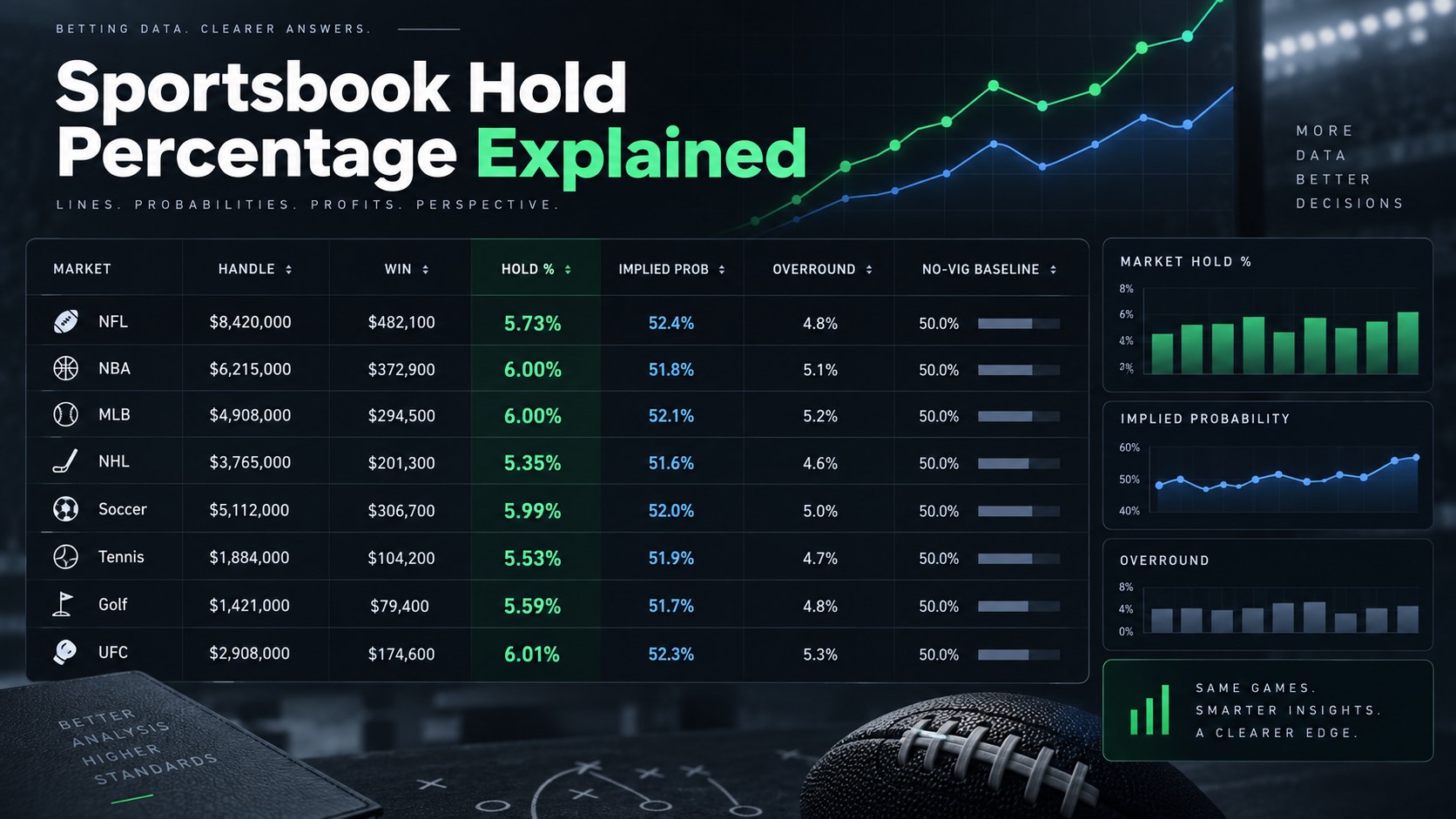
Sportsbook hold percentage shows how much money a book keeps from the amount wagered. Bettors should understand it, but they should not confuse realized hold with the vig built into one specific line.
Last updated: October 22, 2026
Key Takeaways
- Hold percentage is a retained-revenue metric. It compares sportsbook win or gross gaming revenue with total betting handle.
- Vig is the price-level cousin. A sports betting vig calculator measures the margin embedded in a specific market before it settles.
- Overround starts with implied probability. Use an odds converter, add every outcome's implied probability, then compare the total with 100%.
- High hold does not prove every bet is bad. It means the bettor needs a cleaner fair-probability estimate, better line shopping, and more conservative stake sizing.
- Use hold as context, not a pick engine. The bet still has to clear break-even probability and an EV calculator check.
What Is Sportsbook Hold Percentage?
Sportsbook hold percentage is the portion of total wagers that a sportsbook keeps after paying winning tickets. Regulators and industry reports often discuss sports betting through two headline numbers: handle, meaning total amount wagered, and revenue or win, meaning the amount retained after payouts and adjustments.
The simple formula is:
Sportsbook hold percentage = sportsbook revenue / betting handle * 100
If a sportsbook accepts $25 million in bets and reports $2 million in sports wagering revenue, the realized hold is 8%. That does not mean every market had an 8% embedded margin. It means the book kept 8 cents per wagered dollar across that reporting period after results, market mix, promotions, settlement rules, and bettor behavior all played out.
Hold Percentage Example
| Metric | Example amount | What it means |
|---|---|---|
| Handle | $10,000,000 | Total amount customers wagered. |
| Revenue / sportsbook win | $650,000 | Amount the book kept after payouts and normal accounting adjustments. |
| Hold percentage | 6.5% | $650,000 divided by $10,000,000. |
That 6.5% number is useful for reading sportsbook business results or state gaming reports. For one bettor deciding whether to place one wager, it is too broad by itself. The next question is what margin exists in the specific market on the screen.
Hold vs Vig vs Overround
The terms overlap in casual betting conversation, but they are not identical in practice.
| Term | Best use | Example |
|---|---|---|
| Hold percentage | How much the book retained from handle after results. | $700,000 revenue on $10,000,000 handle equals 7% hold. |
| Vig / juice | The price tax embedded in offered odds. | A -110 spread asks bettors to win 52.38% instead of 50%. |
| Overround | Total implied probability above 100% across a full market. | -110/-110 adds to 104.76%, or 4.76% overround. |
| No-vig probability | The normalized market probability after removing margin. | Each side of -110/-110 normalizes to 50%. |
For site-level research, hold percentage tells you how the sportsbook did. For bet-level research, vig and overround tell you how expensive the price is. The two are connected, but realized hold can swing because underdogs won, parlays lost, futures settled, promos hit accounting, or customers concentrated on high-margin products.
Parlays add another pricing layer. Our explainer on how parlay odds are calculated shows how per-leg margin compounds and why same-game correlation changes the combined price.
The Bettor Workflow
When you are looking at an actual market, start with the price rather than a statewide hold number.
- Match the exact market. Same game, period, line, settlement rule, and outcome set.
- Convert every outcome to implied probability. American odds, decimal odds, and fractional odds all need the same probability base.
- Add the probabilities. A market total above 100% is overround. The higher it is, the more margin the bettor has to overcome.
- Remove the vig. Use a no-vig odds calculator to normalize the market and estimate the fair baseline.
- Compare your own fair probability. Only after the no-vig baseline is clear should you test whether your model or research disagrees enough to bet.
- Size the stake. Use unit sizing, flat betting, or a fractional Kelly rule after the edge survives the price check.
Why Hold Can Be Higher Than the Posted Vig
A sportsbook can report a higher realized hold than the theoretical margin on main spreads because customers do not bet a perfectly balanced diet of low-margin markets. Parlays, longshot props, same-game parlays, futures, and niche markets often carry more expensive pricing and more variance.
That is why a state or operator hold report should not be read as a universal tax on every line. It is an aggregate output. If bettors heavily choose high-payout combinations or markets with wider spreads between fair price and offered price, realized hold can rise. If bettors win a week of underdogs, futures, or public sides, realized hold can fall temporarily.
What a Good Sportsbook Hold Percentage Means for Bettors
Lower hold is generally better for bettors because less money is being extracted from the market. But the useful question is not just whether a sportsbook has a low aggregate hold. It is whether the exact market you are betting has a fairer price than the alternatives.
| Hold signal | How to read it | Research response |
|---|---|---|
| Low aggregate hold | The book may have sharper pricing, lower margins, or bettor-friendly market mix. | Still compare each market. Low sitewide hold does not guarantee your line is best. |
| Average hold | Normal sportsbook business result. | Line shop and calculate overround before judging value. |
| High aggregate hold | Could reflect parlays, props, futures, bad bettor selection, or short-term results. | Be extra skeptical of high-margin markets and oversized stakes. |
| Volatile hold | Small samples or swingy outcomes can distort one period. | Use longer windows and separate market-level price from reported revenue. |
Hold Percentage and Expected Value
Expected value is where hold becomes actionable. A market can have sportsbook margin and still contain one mispriced side, but the bettor's fair probability has to beat the offered price after the tax.
Suppose a team is listed at +120, which implies a 45.45% break-even probability. If your fair probability is 48%, the bet has positive expected value before bankroll constraints. If your fair probability is only 44%, the bet is negative even if the sportsbook's overall hold looks low.
That is the clean decision chain: measure the price, remove the market margin when useful, compare your independent probability, then run the positive-EV betting workflow. Hold percentage explains the environment. EV decides the wager.
Market Types With Higher Hold Risk
- Same-game parlays: correlation, custom pricing, and recreational demand can hide expensive legs.
- Player props: lower liquidity and fast injury/news changes can widen the effective tax.
- Futures: long settlement windows, large boards, and limited price competition can create high overround.
- Alternate lines: appealing payouts often come with worse hold than the main spread or total.
- Live betting: speed, latency, and trading uncertainty can make the displayed number more fragile.
Those markets are not automatically unbettable. They just need tighter process: line shopping, fair-probability discipline, smaller stake sizes, and post-bet tracking. If the market is a parlay or correlated ticket, pair the hold check with a same-game parlay correlation review before staking.
How to Use Hold Reports Without Fooling Yourself
State-level sports wagering reports can help bettors understand the business side of the market, especially when they separate handle, revenue, and tax collections. The mistake is turning an aggregate hold report into a bet selection rule.
- Use hold reports for context. They show where sportsbooks earn money, not which team to bet tonight.
- Do not compare one week to one market. A single reporting period can be distorted by results and settlement timing.
- Separate product mix from price quality. A book with lots of parlay action can hold more even if its main markets are competitive.
- Track your own numbers. Use a bet tracker spreadsheet to measure CLV, ROI, market type, and line quality instead of relying on industry averages.
Check the Price Before You Trust the Pick
Juice can analyze a bet slip screenshot, estimate fair probability with multiple AI models, and compare that estimate with the sportsbook price so hold, vig, and EV are easier to audit.
Download Juice on iOSFAQ
What is sportsbook hold percentage?
Sportsbook hold percentage is the share of wagered money the sportsbook keeps as revenue after bets settle. The common formula is revenue divided by handle, multiplied by 100.
Is a 7% sportsbook hold good or bad?
For an operator, 7% hold means the book kept 7 cents per wagered dollar over that period. For a bettor, it is only context. The actionable number is the overround and break-even probability on the exact market being considered.
Why do sportsbooks have different hold percentages?
Hold varies by market mix, customer behavior, promotions, pricing, results, limits, parlay volume, and reporting period. A book with heavy parlay or futures action may report higher hold than one with mostly main-market straight bets.
Does lower hold mean positive EV?
No. Lower hold makes the price environment friendlier, but positive EV requires your fair probability to beat the break-even probability of the offered odds.
How is hold different from no-vig odds?
Hold is the retained share of handle or the margin signal in a market. No-vig odds remove margin from the listed prices to estimate each outcome's fair market probability.
Sources
- New York State Gaming Commission: mobile sports wagering reports
- American Gaming Association: State of the States 2026
- Smarkets: how to calculate implied probability in betting
- Pinnacle: betting margins and overround
- National Council on Problem Gambling: responsible gambling resources
BetResearcher is an independent research site. This guide is educational, not financial advice or a guarantee of profit. Sports betting involves risk, and you should only bet where legal and with money you can afford to lose.