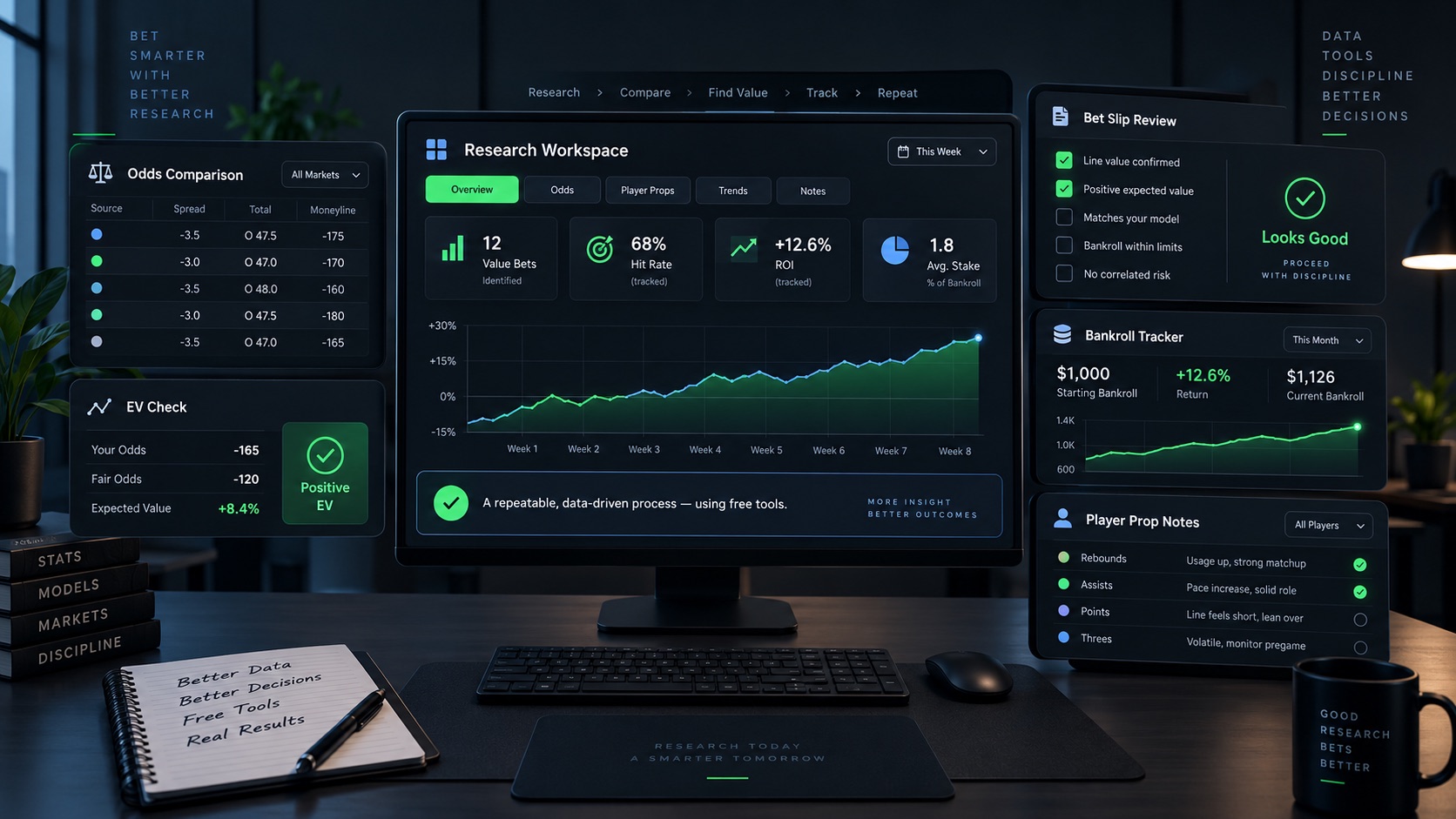
Quick answer: the best free sports betting research app setup is not one app. It is a small stack that helps you answer six questions before you bet: is this market worth researching, what price is available, what probability is implied, what probability do you believe is fair, how much should the stake be, and how will you review the result later?
That matters because the sportsbook already has a stack. It has pricing feeds, risk rules, margin, and a history of how bettors behave. A free bettor does not need to match the entire operation. But they do need a repeatable process. Start with the free layer, then upgrade only where the bottleneck is obvious.
The Free Research Stack
A free workflow should do five jobs well enough to make bad bets easier to reject. If it cannot do that, it is just content consumption wearing a software costume.
Use an odds converter to turn American odds into implied probability.
Use a no-vig odds calculator before treating the market as a fair forecast.
Use an EV calculator to compare your fair probability with the book price.
| Workflow job | Free tool type | Pass/fail question |
|---|---|---|
| Market scan | Free odds comparison, sportsbook odds pages, alerts, or a lightweight tools directory | Is there a materially better price than the one you first saw? |
| Probability translation | Odds converter, no-vig calculator, break-even probability guide | What win rate does this price require after accounting for vig? |
| Bet quality review | EV calculator, bet slip checklist, parlay correlation check | Would you still bet this if it were a straight, boring, trackable decision? |
| Context research | Official injury reports, box-score databases, player usage pages, weather sources | Is your probability estimate based on current context or stale assumptions? |
| Result review | Spreadsheet tracker, CLV log, bankroll tracker | Are your decisions beating closing price, or are wins hiding bad process? |
Where Free Apps Are Strong
Free tools are strongest at forcing discipline. They make you slow down, compare prices, convert odds, write down the fair probability, and track whether the bet was actually placed at a good number. That is a huge improvement over betting from a social post, sportsbook boost label, or gut feeling.
Free tools are also excellent for learning the language of better betting. You can practice line shopping with the line shopping guide, estimate breakeven rates with the break-even odds guide, and size positions with the unit size calculator before paying for an advanced screen.
BetResearcher rule: if a free workflow cannot explain why a bet is attractive, a paid app probably should not be trusted to make the decision for you. Paid software should compress a process you understand, not replace your judgment.
Where Free Apps Break Down
The free layer usually breaks in three places: speed, coverage, and history. Free odds pages may not refresh fast enough for stale-line hunting. Free prop research may not cover every sportsbook, alt line, or derivative market. Free tracking may require manual logging, which means the data gets worse when volume rises.
That is where a paid sports betting analytics software product or bet tracking workflow can make sense. The upgrade is not magic. It is operational leverage. If the app covers your books, exports your bets, records closing line value, and reduces missed prices, the subscription can be evaluated like any other cost.
A Free Workflow for Different Bet Types
Use the same skeleton for every bet, then add the research module that fits the market.
Sides and totals
Start with price shopping, translate the best number into implied probability, remove the market vig, and decide whether your fair probability is high enough. Then log the bet and review CLV. This is the cleanest use case for free tools because the math is direct.
Player props
Free prop research needs more context. Check role, minutes or snap share, matchup, injury news, market movement, and whether the prop is correlated with other legs. Pair the player props research guide with the player prop workflow comparison before deciding whether a paid prop database is worth it.
Parlays and bet slips
Free tools can stop the worst parlay mistakes. Use a bet slip review workflow, check same-game correlation, compare each leg separately, and reject the ticket if one weak leg is only there to make the payout look better.
When to Upgrade
Upgrade from free sports betting research apps when the paid tool solves a measurable problem. The problem might be sportsbook coverage, alert speed, automated bet tracking, historical prop data, exportable notes, or an AI review layer that catches context you routinely miss.
You miss prices because free odds checks are too slow or manual.
You need more books, prop markets, line history, or alt-line context.
You need automatic tracking, CLV, tags, notes, and weekly review data.
If you are comparing paid products, use the sports betting app comparison checklist before looking at logos. The right app depends on whether your bottleneck is odds, EV, props, slip review, tracking, or bankroll control.
Recommended Free-First Path
- Pick one market type for two weeks: sides, totals, player props, or slips.
- Use the best free sports betting tools page to choose the basic stack.
- Convert every price into implied probability before writing a pick.
- Run the EV check only after you can defend your fair probability.
- Track stake, odds, closing price, result, and a one-sentence pre-bet thesis.
- Upgrade only when the free workflow creates a clear recurring bottleneck.
Sources and Further Reading
- National Council on Problem Gambling helpline information for responsible-gambling support.
- American Gaming Association responsible gaming resources for consumer safeguards and betting limits.
- BetResearcher sports betting software stack for the paid-tool version of this workflow.